Mahlon's Story: A True Survivor
Mahlon Conaway has been involved in a lot of battles in his lifetime. Fighting cancer may have been the least frightening.
A 96-year-old World War II veteran, he still lives independently in the Perry, Iowa, home he has owned for more than 60 years.
“I try to keep my house clean, and the yard trimmed up,” Conaway says with a laugh. “There is still a lot to do before winter.”
Conaway’s WWII story starts in 1944, when he tried to enlist in the Army at age 18 after his older brother was drafted. At first, they didn’t take him.
“I think maybe I didn’t weigh enough,” he says. “I only weighed about 100 pounds.”
But three months later, Conaway got called for the draft and began his infantry training at what is now known as Fort Hood, Texas. When he was sent overseas, he landed at Omaha Beach, three- and- a- half months after D-Day.
“The advantage I had was nobody was shooting at me when we landed,” Mahlon says. “I can’t imagine what it would have been like if someone was shooting!”
Conaway spent 20 months overseas and saw a lot of combat. He sustained multiple injuries and went through several different hospitals, including being hospitalized in Paris, France, on Christmas Day. Yet, officially, he was never categorized as having been wounded.
“I’m not sure why,” he says. “Probably because they were too busy to mess with paperwork the first time and the rest of them thought I had already been documented.”
One battle stands out to Conaway because it was the moment when he lost a portion of his hearing. He was in the Alsace area of France taking fire from the German soldiers. As they approached the Siegfried Line, a 400-mile defensive line along the western German border, they noticed more artillery coming their way.
“You get to know how far away artillery fire is by the sound it makes when it’s coming in,” Conaway says. “We were near a big pillbox [a fortified structure] that had two large steel doors. That’s when we heard a shell coming in from their huge railroad gun and knew it was right on target.”
The Schwerer Gustav was one of the largest guns in the German arsenal and was capable of firing shells weighing seven tons to a range of 28 miles. It can be seen in a famous photograph of the men of the 36th Division, 142nd Infantry, including Conaway standing atop of it in the rail yard in Kaiserschlact, Germany, after it was captured.
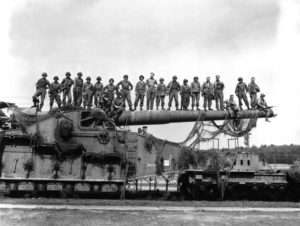
“Everyone ran into the pillbox, and my buddy and I knew we had to get both of those steel doors shut if we had a chance of making it,” Conaway says.
Moments before the bomb landed directly on their pillbox, they got the doors shut,and everyone survived the direct hit. They normally wouldn’t have had time to get the doors closed, but they discovered later that because it was a low velocity shell, it took a few seconds longer to hit its mark. It was enough of a delay to save their lives, but the blast was so loud thatConaway’s hearing was irreparably damaged.
After the war, Conaway returned to Perry, where he has lived for most of the last 77 years. He began driving a truck for Ruan Transport when he was 25 and spent 36 years with the company. During that time, he discovered he had prostate cancer, which was treated and cured.
More than 40 years later, doctors discovered squamous cell carcinoma of the skin on Conaway’s right ear.
“I took radiation at the time, and that seemed to work,” he says. “But then, in May of 2019, it came back.”
Surgery and radiation were used to treat the cancer, but he experienced a local recurrence in the right ear.
In February 2020, Mahlon came to Mission Cancer + Blood.
“This type of cancer has been known to be aggressive,” says Angie Stratton, RN, BSN, physician nurse for Brian Freeman, MD, Conaway’s doctor at Mission Cancer + Blood. “His PET scan showed it had spread to his upper neck and jaw, and there were also lesions on his liver.”
Because the cancer had spread, neither surgery nor radiation were treatment options. Freeman was aware of a recently approved drug for this type of cancer, but it was new, and he had not yet used it. He discussed the treatment to Conaway, and beginning in February 2020, Conaway went to Mission Cancer + Blood every three weeks for a year to receive his treatments.
“Side effects are always a potential for any kind of cancer treatment,” Stratton says. “But every time Mahlon came in, he said he was doing great, no side effects at all. He just kept moving through it with such a positive attitude.”
After six months of the treatment, scans showed a major reduction in the size of Conawayt’s cancer. At the end of his treatment, the cancer was completely gone.
Just like closing those doors to the pillbox in time, it worked.
“Dr. Freeman knew what he was talking about,” Conaway says. “I just had my six-month scan, and it’s still clear.”
“This was just an awesome response to treatment,” Stratton says. “Not only did the cancer completely resolve internally, but his ear healed fully, as well. It’s truly amazing.”
Conaway is grateful for everyone at Mission Cancer + Blood who helped him through his most recent battle. The nurses at Mission reminded him of the many nurses who cared for injured soldiers wounded in the war.
“When I was lying in bed in the hospitals over there, I would watch what the nurses did,” he says. “They were fantastic, and the nurses at Mission Cancer + Blood were just as fantastic.”
The pandemic added an extra layer of complexity to everyone’s jobs, but it didn’t affect Conaway’s experience.
“They treated me like I was the only person that was coming in there,” he says. “They just care so much. I feel very fortunate.”
Stratton looks forward to the days Conaway comes back to Mission Cancer + Blood for appointments.
“When I see his name on the schedule, I’m excited to talk with him and catch up,” she says. “You would never guess he was 96!”
Conaway has earned some impressive honors from his service to our country . They include a European Theatre of Operations Medal, Bronze Star for Valor, Army of Occupation Medal, French Foreign Legion Honor, and a Good Conduct Medal.
But he’s still a humble man whose outlook on life is pretty simple. He doesn’t get hung up on his age.
“It’s just a number,” he says. “Some people think when they reach 65, they can’t do anything anymore, but you can. It’s all about how you choose to live.
“I can still move around, I’m still living in my home and still working in the yard,” he says. “I’m just a little guy trying to survive.”
What a true survivor he is.