A winding cancer journey leads back to care closer to home
Though he was willing to do “whatever it takes,” prostate cancer survivor Roger Kimball’s cancer journey was made easier by receiving care from his local Mission Cancer + Blood care team in conjunction with specialists from University of Iowa Health Care.
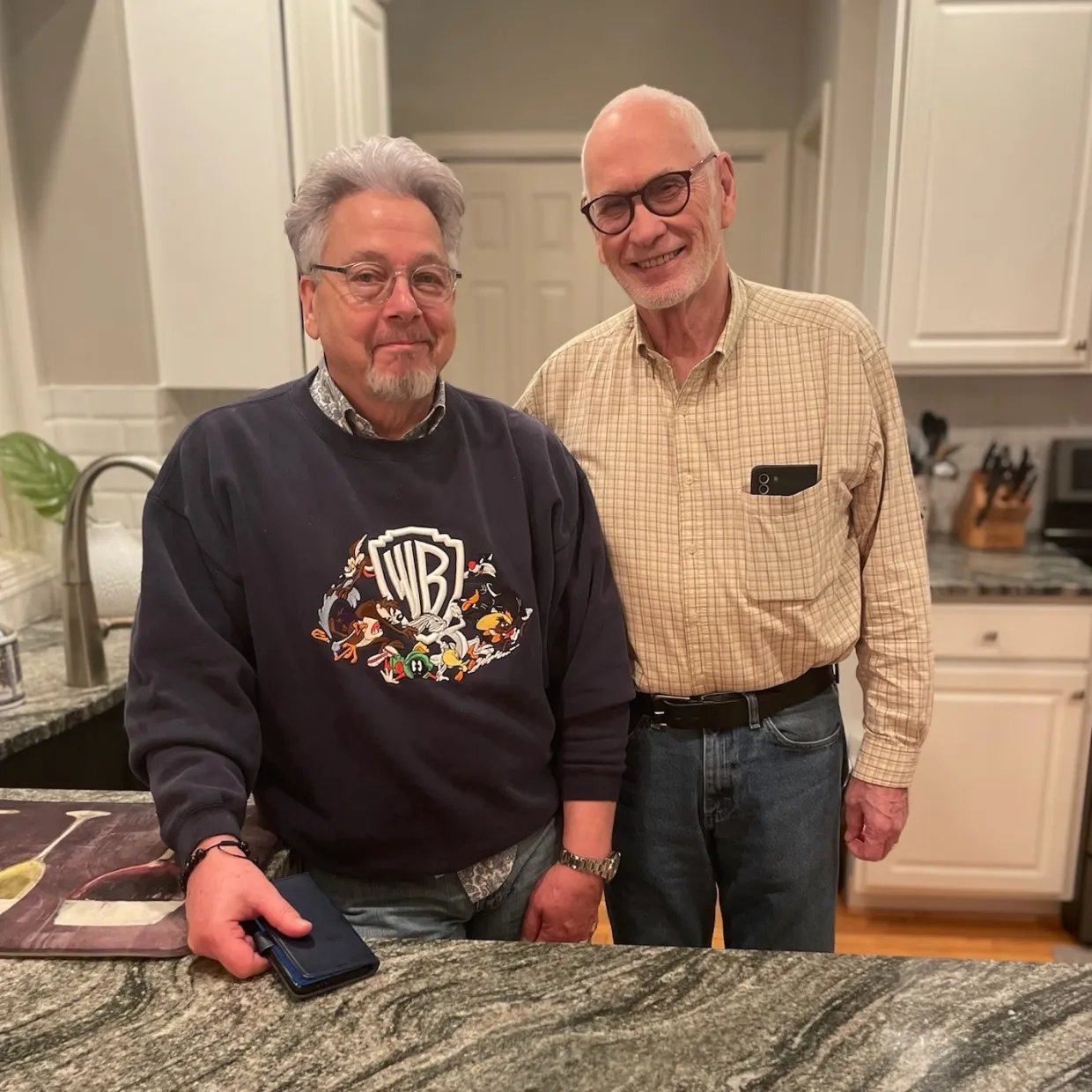
For Roger Kimball, the hardest parts of cancer treatment have not always been the procedures or the lab results. Often, it has been the uncertainty between appointments, the anticipation of test results, and the quiet discipline of continuing with daily life while cancer remained in the background.
His cancer journey began quietly: not with symptoms he could feel, but with a number on a lab report. While living in California in 2000, at a doctor’s visit he learned his prostate-specific antigen (PSA) levels were higher than expected. But after some nonconclusive testing and no clear path forward, he did what many people do when a warning doesn’t feel urgent – he moved on with his life. Years passed, he and his husband Gary relocated several times, and with no real symptoms, the anxiety slipped into the background.
A routine physical in 2009 brought the concern sharply back into focus. His PSA had climbed to 15.9 (a normal range is generally considered under 4.0) and a biopsy confirmed his delayed fears: prostate cancer. His prostate was removed via surgery, followed by radiation. It worked for a while, but then his numbers began to rise again.
Next came hormone therapy, which is often effective, but also often impacts a patient’s day-to-day life with fatigue, hot flashes, weight gain. Kimball experienced it all. Even so, he kept doing what needed to be done, trying to make room for treatment without letting cancer take over every part of his life.
When the couple eventually moved to Iowa in 2016, Kimball knew he needed to find an oncologist to help monitor his disease. During his search in Des Moines, it took a few tries to find a physician who genuinely seemed interested in his concerns, his fears, and his questions about advanced imaging and treatment options. Eventually he found his way to Bradley Hiatt, DO at Mission Cancer + Blood, and for the first time in a long time, he felt he had someone in his corner.
“In that first meeting with Dr. Hiatt, I finally felt like someone was really listening to me,” Kimball says. “Dr. Hiatt is a godsend.”
By then his PSA levels had risen to more than 300, and the choices ahead felt serious. Hiatt explained the options, which included more hormone therapy, chemotherapy, and more aggressive treatments. One thing came through clearly: the decision belonged to Kimball.
Kimball decided to first try chemotherapy and hormone therapy together, but it was a lot for his body to manage. Then his care team at Mission noticed a heart murmur, which led to a valve replacement via transcatheter aortic valve replacement (TAVR) procedure.
“The alternative would have been open heart surgery but because I was a cancer patient in treatment, I qualified for the less-invasive TAVR procedure. I guess you could call that a silver lining of having cancer,” Kimball says.
That surgery was successful, but his prostate cancer continued to progress. Hiatt discussed that a next logical treatment would be theranostics, which uses targeted radiation to find and attack prostate cancer cells throughout the body.
“I had heard of theranostics earlier in my cancer journey, but at the time, it would have required me to travel to Iowa City or Omaha, and I decided to pursue other treatments first,” Kimball says.
Kimball now had the option to receive the treatment much closer to home at the Mission Waukee Clinic, in conjunction with specialists from University of Iowa Health Care. Members of the nuclear medicine team in Iowa City travel to the Des Moines Metro regularly to administer the treatment and work collaboratively with their local Mission oncologists, helping patients like Kimball avoid the added burden of long-distance travel during an already demanding time.
“At this point, I would have traveled to get the treatment, but it made an enormous difference to be so close to home,” Kimball says.
After treatment, instead of riding for hours in a car, he was able to drive across town, walk into his own home, and rest in his own bed.
Though fatigue was real, Kimball says he tolerated theranostics much better than some of the earlier treatments he had tried. After four sessions, his numbers had come down significantly, giving him and his care team hope for what could come next, a result they had been working toward for years.
Kimball is grateful that theranostics was a treatment option that worked well for him. But even more so, he says he is grateful he found a team he trusts.
He says he values the consistency in seeing the same friendly faces at every visit to the clinic, and that those friendly faces not only understood his diagnosis, but his personality, his preferences, and even his worries.
“Dr. Hiatt, his care team, the doctors from Iowa City, and everyone at Mission could not have been more compassionate, attentive, and coordinated in their care,” Kimball says.
Today, Kimball and his husband are taking life one day at a time and keeping things as ordinary as possible. They watch movies, run errands, and enjoy their life together finding comfort in the routines that continue even as cancer remains a daily thought.
Kimball’s cancer journey has taken him through years of uncertainty, difficult treatments, and decisions he never expected to face. But today, that journey has also led him to something deeply meaningful: care close to home, a team he trusts, and the chance to keep living the life he values.