Theranostics: a two-part approach that is advancing cancer treatment
Theranostics combines advanced imaging with targeted therapy to detect and treat a range of cancers.
A more precise way to treat cancer
If traditional cancer treatments are no longer working well or are not the right fit, theranostics may offer another option.
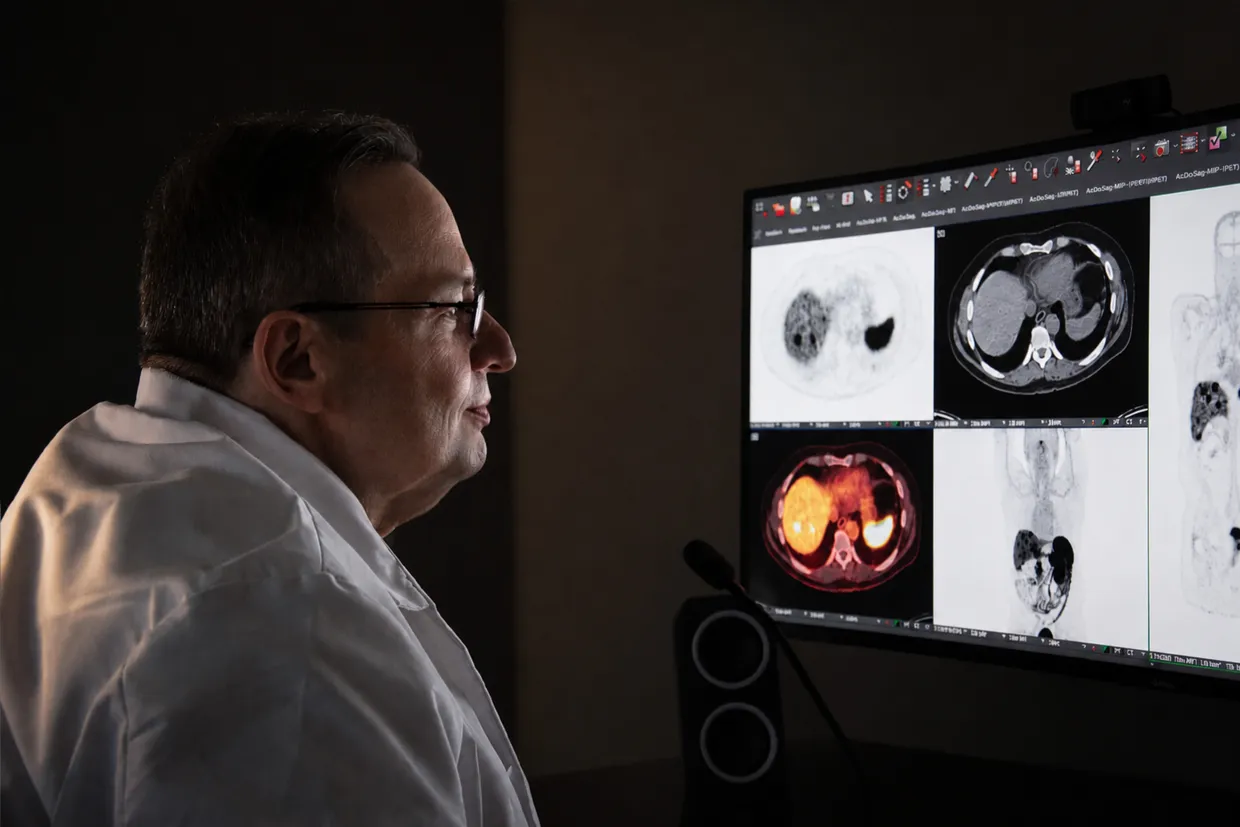
Theranostics can help your care team target cancer more precisely without damaging the healthy tissue surrounding it. It combines imaging and treatment so that doctors can see whether a therapy is likely to reach tumor cells before treatment even begins.
Theranostics uses imaging first to show whether the tumor has the right target for treatment. If it does, therapy can then be matched to those same cancer cells.
“We actually can confirm that the treatment drug will go where it needs to go to be the most effective,” says Yusuf Menda, MD, a nuclear medicine specialist at UI Health Care. “Theranostics allows cancer treatment to be much more targeted to reduce the side effects of cancer treatment and improve the quality of life.”
For some patients, theranostics can offer another path forward. At UI Health Care, this innovative option is supported by deep experience in theranostics and advanced imaging.
How theranostics works differently
Theranostics is a form of radiation therapy, but instead of delivering radiation from outside the body to one or two known areas, it uses a radioactive drug (radiopharmaceutical) that travels through the body and seeks out cancer cells. These radioactive drugs have two parts: a targeting component that binds to tumor cells, and a low-energy radioactive component that allows doctors to image the cancer. Once the tumor locations are known, the same targeting molecule is then paired with a higher-energy radioactive isotope that kills the cancer cells.
“For patients whose cancer has spread to other organs or other parts of the body, it can irradiate all lesions at the same time,” Menda explains.
With theranostics, treatment drugs are designed to seek out a specific target on the tumor and deliver radiation more precisely to it.
“This type of treatment uses a smart molecule that binds to the receptors that are specific to the tumor,” he says.
For some patients, that means a more precise way to treat cancer throughout the body while limiting harm to surrounding, healthy tissue. At UI Health Care, this approach is backed by a long and successful track record.
Why choose UI Health Care for theranostics
UI Health Care offers patients in Iowa access to a theranostics program built on advanced imaging, specialized expertise, and a strong foundation in research. As a leading PET imaging center and a Society of Nuclear Medicine and Molecular Imaging-designated Comprehensive Radiopharmaceutical Therapy Center of Excellence, UI Health Care also brings deep experience in both the diagnostic and therapeutic sides of theranostics.
“We have state-of-the-art imaging,” Menda says. “And we have an outstanding group of clinicians and scientists who are working together.”
This combination has helped make UI Health Care a recognized leader in theranostics. UI researchers have helped advance important work in neuroendocrine tumors, including clinical research that supported Food and Drug Administration (FDA) approval of Ga-68 DOTATOC, a PET imaging drug used to help locate neuroendocrine tumors.
Menda says UI Health Care was doing investigational work in this area long before some therapies were approved. Some of this research dates back to 2001.
“For 15 years, before theranostics studies were approved by the FDA, we were getting patients referred from all over the country for our clinical trials,” Menda says.
This long track record continues today through specialized care, clinical trials, and national research leadership. UI Health Care is also home to the country’s only Specialized Programs of Research Excellence (SPORE) grant in neuroendocrine tumors.
“University of Iowa Health Care has very unique strengths and a long track record of providing state-of-the-art theranostic therapies,” Menda says. “We are well recognized nationally as a site for theranostic treatments.”
What theranostics treatment can look like
For many patients, theranostics offers a more personalized approach to treatment — especially when other therapies are no longer working well or are not the right fit. Today, two of the best-established uses are certain neuroendocrine tumors and metastatic prostate cancer. In neuroendocrine tumors, doctors can target somatostatin receptors; in prostate cancer, they can target prostate-specific membrane antigen, or PSMA.
Because many prostate cancer cells have high levels of PSMA, doctors can use imaging to find those cells and determine whether a targeted radiopharmaceutical therapy may be an option.
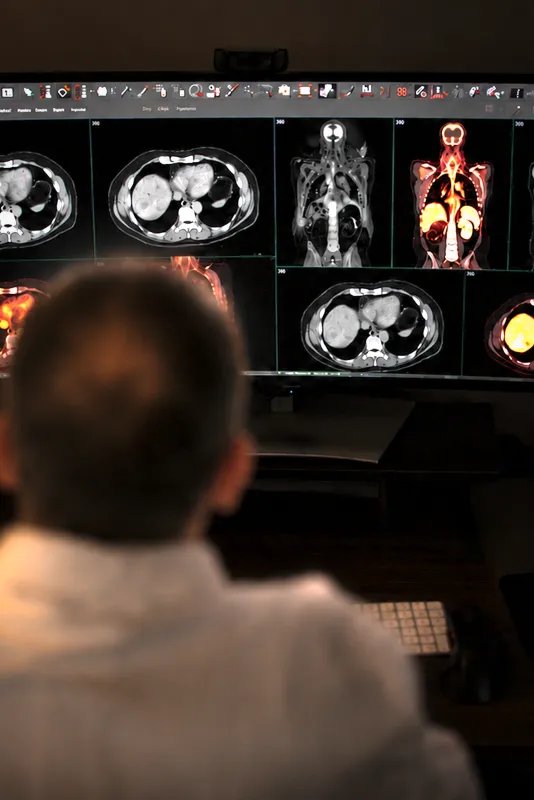
Patients first get imaging with a specific PET scan to see whether the cancer has the right target for therapy.
“The first step is to determine if the treatment is appropriate for this patient,” Menda says.
If the scan supports treatment, the patient then meets with the care team for a theranostics consultation. This visit includes a review of imaging, possible side effects, and lab work to check kidney and bone marrow function.
Theranostics imaging can also help the care team evaluate the risk of side effects. From there, the treatment is tailored to the individual patient.
“Every dose is specific to the individual patient,” Menda says.
For metastatic prostate cancer, treatment is commonly given every six weeks 4-6 cycles. For neuroendocrine tumors, treatment is given every 8 weeks over 4 cycles, over several months. During that time, patients are monitored closely with lab tests, tumor markers, and imaging to see how treatment is going.
What cancers can theranostics treat right now?
Theranostics is already part of standard care for some cancers, and this list is expected to grow. Today, it is most commonly used for:
- Thyroid cancer
- Prostate cancer
- Neuroendocrine tumors
- Some bone metastases related to prostate cancer
“They are all clinically approved,” Menda says. “Research is ongoing and substantial for this type of treatment in hopes that we can expand the list of cancers that theranostics can treat.”
At the same time, the field is expanding. Researchers are studying how theranostics may be used in other cancers, including pancreatic cancer, breast cancer, lung cancer, melanoma, and others.
At UI Health Care, patients have access to theranostics experts with extensive experience and active clinical research. Holden Comprehensive Cancer Center has more than a dozen active and pending theranostics clinical trials, giving some patients access to emerging treatment options not widely available elsewhere.
The future of theranostics in cancer care
Theranostics is still a growing area of treatment, and researchers are working to expand its use for more cancer types.
“I think the expectation is that there will be many more radiopharmaceuticals developed that will be targeting different tumor types,” Menda says.
Researchers like Menda are also working to make these treatments even more precise while reducing side effects.
“We’re working to make it even more effective and targeted,” he says.
For patients, this could mean more theranostics treatment options and more personalized care in the years ahead. At UI Health Care, that future is already taking shape through research, clinical trials, and ongoing work to bring new therapies to patients.