From curbside to critical care: Valet supervisor’s quick actions lead to lifesaving care
An ordinary day near the front doors of UI Health Care’s university campus medical center quickly turned extraordinary when several employees came together to take lifesaving action.
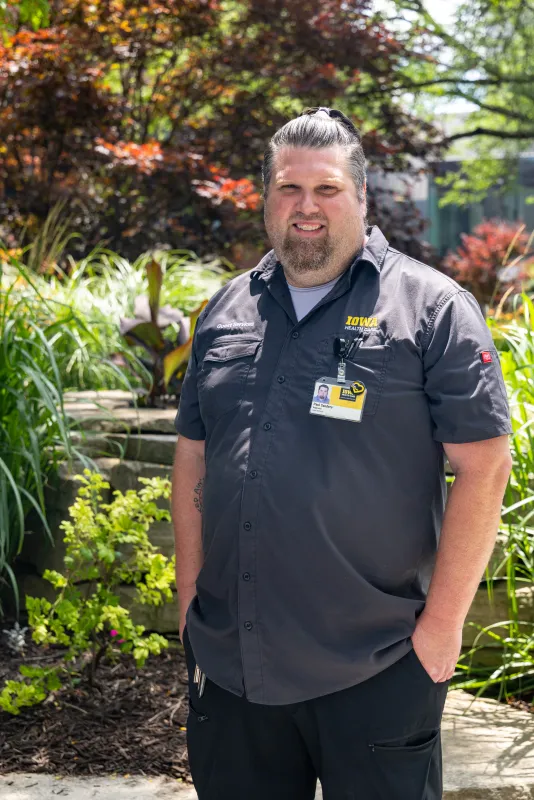
It was just after 5:30 a.m. when Paul Sanders, a valet supervisor, noticed a vehicle parked outside the main entrance at the university campus, unattended. As he walked over to check on the car, he noticed that the driver had already entered the building, but a passenger was still inside.
“When I got to the car, I could tell that the person in the passenger seat was in distress,” Sanders says. “They were talking a lot, sweating profusely, and had a vomit bucket with them.”
He quickly learned from the patient’s family member that they were looking for the Emergency Department (ED). Sanders immediately stepped in to help guide them.
“I remember saying, ‘We’re going to get you there right now,’” Sanders recalls.
The patient’s family tried to help them out of the car, but Sanders saw that they were struggling.
“Not knowing exactly what was wrong with the person or how severe the situation was, I wanted to get them moved to the ED as quickly and safely as possible,” he says. “So, I asked if I could take over to help get the patient into a wheelchair so we could get them moving.”
Extending service beyond the entryway
Sanders’ calm composure during the high-stress situation back in August 2024 comes from years of experience. In his 18-year career at UI Health Care’s university campus, he’s responded to more than a few medical emergencies at the front doors.
“This isn’t the first time someone’s pulled up in distress at the Main Entrance,” he says, noting that he’s even had to help deliver a baby in the past.
When Sanders turned to wheel the patient inside, a former valet greeter readily jumped in to help. The teamwork between the two was immediate and instinctive.
“When unprepared moments like this pop up, stepping in and communicating is critical,” he says. “We’re essentially forming a gameplan as we go and just want to make sure that we take care of the patient as best as we can.”
As he and the other valet greeter began heading toward the ED, Sanders noticed that the patient’s condition was getting rapidly worse, so he tried to keep them talking and let the patient know that he was there with them.
“Their speech started to soften,” Sanders says. “Their hand that was holding onto my arm started to get weaker. We picked up our pace a little bit more, and then about two-thirds of the way there, their hand just fell off and they stopped talking.”
Every role matters
They were nearly at the ED when an environmental services team member saw what was happening and rushed to help.
“They opened up the doors for us and yelled for the front desk to get staff,” Sanders says. “Nurses immediately entered the waiting room and were able to then take the patient back for needed treatment.”
A nurse later told Sanders that his actions saved the patient’s life and gave them a chance to survive.
“During the event, there was just extra adrenaline,” he notes. “Afterward, I kept wondering, ‘Did I do enough? Did I make all the right decisions?’ You start to second-guess yourself a little bit, so that confirmation really brought me a sense of relief.”
Sanders hopes the experience can remind all UI Health Care employees to stay observant and be ready to act if ever needed.
“I just think the key thing is to not ever look past someone,” he says. “We’re the face of the hospital. We see so many people every day. Don’t be afraid to walk up and talk to somebody and ask if they are okay.”