From misunderstood to mutual understanding: Nurse shows the power of bilingual support in patient care
When a patient became frustrated due to a language barrier, staff nurse Diana Marquez stepped in to help—turning a potentially dangerous situation into one of understanding and trust

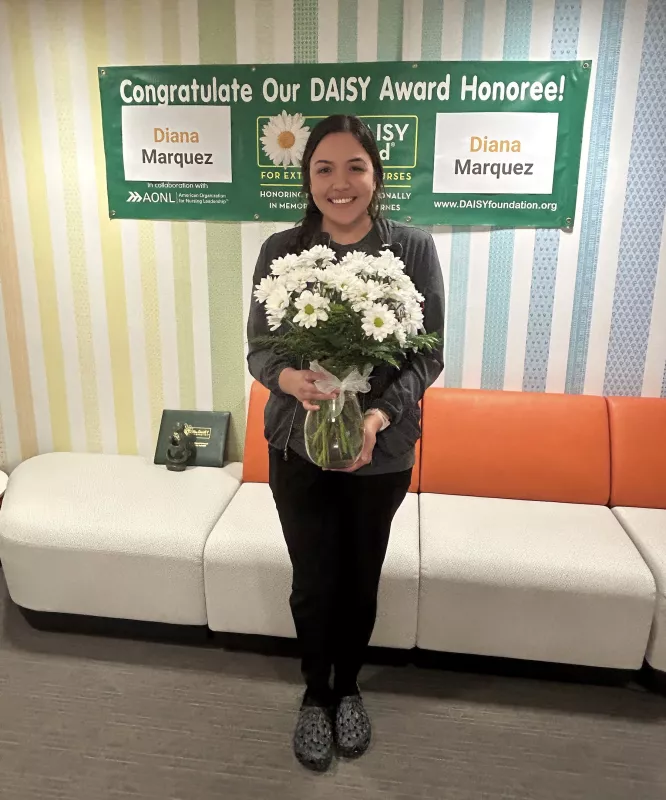
Diana Marquez, RN, has always made it her mission to make a difference in the lives of her patients at UI Health Care. Her commitment was on full display when she used her bilingual skills and sound judgment to ease a challenging situation in the Neuro-Epilepsy Monitoring Unit at the UI Health Care Medical Center - University Campus last year.
The patient, who primarily spoke Spanish, was determined to leave the hospital despite the risks posed by extreme temperatures and their medical condition. Unable to effectively communicate their concerns to their care team, the situation grew tense. Fortunately, Marquez was already there, ready to bridge the gap.
“When I arrived, Diana was not only able to give her assessment of the patient but also interpreted for both of us since I’m not fluent in Spanish,” recalls Chris Merriman, MD, a psychiatry resident. “With her help, we were able to come to a mutual understanding with the patient and create a plan that prioritized their safety.”
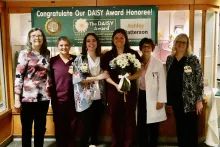
Her calm presence and ability to connect with the patient not only de-escalated a potentially dangerous situation for the patient but also earned herself a DAISY Award. Merriman, who nominated Marquez, was inspired by how she went above and beyond to ensure the patient felt heard and understood in a challenging moment.
“Without her being present and able to remain calm and level-headed with the patient, I do not believe that the situation would have been resolved on such a good note,” he states.
Building trust, easing tension
Marquez humbly states that her bilingual skills don’t just facilitate communication—they build trust and often lead to better outcomes for patients, families, and care teams. “When I can speak with patients in their language, it eases their fears and helps them feel more comfortable in the hospital setting,” she says.
“Nurses are alongside our patients every step of their care journey, from the moment when they are admitted until they leave the hospital,” she adds. “We have lots of meaningful interactions and conversations with our patients, we are their caregiver and their advocate. At the end of the day, it's very fulfilling to help someone in need. People will remember how you made them feel."
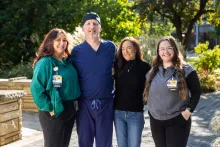
Marquez is quick to share credit for the positive outcome and says she was grateful to have colleagues who could cover her other patients while she was helping to translate and find a safe solution for the patient.
“Our nurses really make a great team,” she notes. “We spend more time with the patient than just about anyone else. This was a moment where we were able to have a positive outcome. In this field we are going to encounter people whose emotions are dysregulated, and we want to be able to prevent a situation from getting worse. Sometimes it starts by just paying attention.”