Expertise—and relationship-building—in infertility care
Through personalized care and earned trust, reproductive health specialists at West Des Moines clinic help patient navigate path to successful pregnancy.
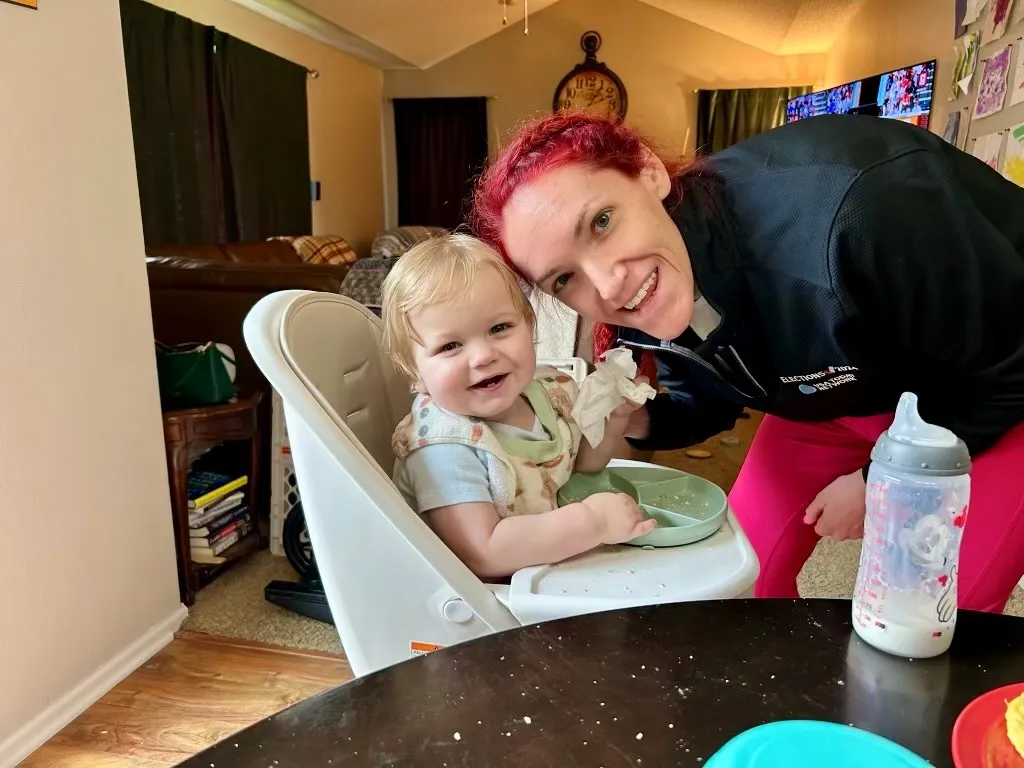
A few weeks after giving birth to her first child in May 2024, Courtney Crowder was shopping with her newborn son, Clark, strapped to her chest. As she and her husband were wrangling what they needed as part of their new-parent life, a woman came up and said hello.
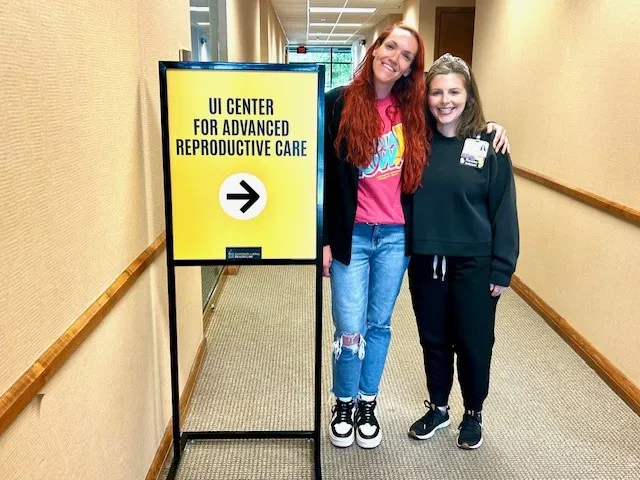
This wasn’t an unusual occurrence. Crowder is a senior writer at the Des Moines Register. This encounter was special, however, because the woman greeting Crowder was Courtney Goad, PA-C, a physician assistant in obstetrics and gynecology at University of Iowa Health Care West Des Moines, Jordan Creek Parkway. Goad had helped Crowder on her fertility journey at the clinic, which included one pregnancy loss. It was Goad who delivered the heart-wrenching news during Crowder’s previous pregnancy.
And this time, it was Goad who was nine months pregnant.
“It just felt like the universe was bringing us together to say it’s OK. There is a path. There is a plan here,” Crowder says.
Providing greater access to reproductive care
Crowder is one of the thousands of patients who have come to UI Health Care for fertility care. UI Health Care’s in vitro fertilization (IVF) program, based in the UI Center for Advanced Reproductive Care on the health system’s university campus in Iowa City, was started in 1987. Over nearly 40 years, the program’s specialists have performed more than 10,000 IVF procedures, resulting in close to 10,000 births. UI Health Care has the highest success rate in Iowa—10% higher than the national average for pregnancy success.
The West Des Moines clinic opened in 2020, with the goal of making IVF and other kinds of fertility care available to more people—offering fertility testing, fertility preservation, intrauterine insemination, and IVF procedures. They also see patients with polycystic ovary syndrome, endometriosis, and other conditions that affect women of reproductive age. Since its opening, the West Des Moines clinic has seen more than 4,000 patients.
“Our goal of operating this clinic is to increase access to care for patients around Iowa and other states,” says Abigail Mancuso, MD, reproductive endocrinologist at the West Des Moines clinic.
Patients’ mental health can be affected by ‘stigma’ of infertility
For patients, the clinic offers much more than a menu of services. Mancuso and Goad understand the physical and mental highs and lows that are often part of reproductive care.
“Infertility can still bring a lot of stigma,” Mancuso says. “It can be an isolating experience.”
That’s true even if infertility itself is not uncommon. According to a National Health Statistics Report, 16.3% of married women ages 15 to 49 experience some form of infertility, and 8.5% are infertile. Conceiving through fertility assistance is not uncommon. A KFF report found that 13% of reproductive age women say they or their partner have needed fertility services to help them become pregnant or prevent a miscarriage.
A lot of babies are now in this world because of fertility help, too. According to the American Society for Reproductive Medicine, 95,860 babies were born from IVF in the U.S. in 2023, accounting for 2.6% of births in the country. That’s up from 91,771 IVF births in 2022.
Greater awareness of infertility and reproductive medicine hasn’t made that stigma of it go away, however. According to a study from Dialogues of Clinical Neuroscience, 30% to 60% of women with infertility experience changes to their mental health. This is one reason why caring for the whole patient is important to the clinic’s providers and staff, especially when patients experience pregnancy loss.
“I see the value in really getting to know my patients and creating relationships and true partnerships,” says Goad about her approach to her work at the clinic.
Pregnancy, heartbreak, hope ... and a happy outcome
Crowder came to the West Des Moines clinic on the advice of her OBGYN doctor after a year and a half of trying to get pregnant.
“I am a type-A, gold star kind of girl, and I had been tracking and trying multiple ovulation testers and different pills,” she says. “It was just dead end, dead end, dead end. Nothing was working.”
There was no identifiable issue at play, which is true for many patients when it comes to not being able to conceive. Crowder’s OBGYN specialist suggested fertility treatment. She was told that “if we wanted to have a baby, we had to move on,” Crowder says.
After trying intrauterine insemination, which places sperm directly on the uterus, she had her first egg retrieval for IVF in September 2022. That resulted in one viable embryo and, by October, a pregnancy. Crowder was “over the moon,” she says.
The seven-week scan showed a strong heartbeat and no problems, and things looked so good that she didn’t even technically need the scan scheduled for two weeks later.
“But I’m in love with these people—the nurses and Dr. Mancuso. They’re my friends, why would I not come to the nine-week scan?” Crowder says.
But at nine weeks, something wasn’t right. The fetus, a girl, was no longer healthy. She had a malformed heart, a halo around the brain, and fluid on the skin. She was "incompatible with life,” Crowder was told, and would not live, if she even made it to full term. In December, Crowder terminated the pregnancy.
Goad delivered the news at the nine-week scan. Where the best part of being a provider in this kind of setting is telling a patient they’re pregnant, the opposite is also true.
“We get to know them. We spend a lot of time with them. We feel a lot of the lows,” she says. Negative pregnancy tests and miscarriages are “definitely the hardest part,” Goad adds.
Crowder didn’t give up. In 2023, she had another egg retrieval, which resulted in one viable embryo. After genetic testing, given what happened with her first pregnancy, she proceeded. Nine months later, Clark was born.
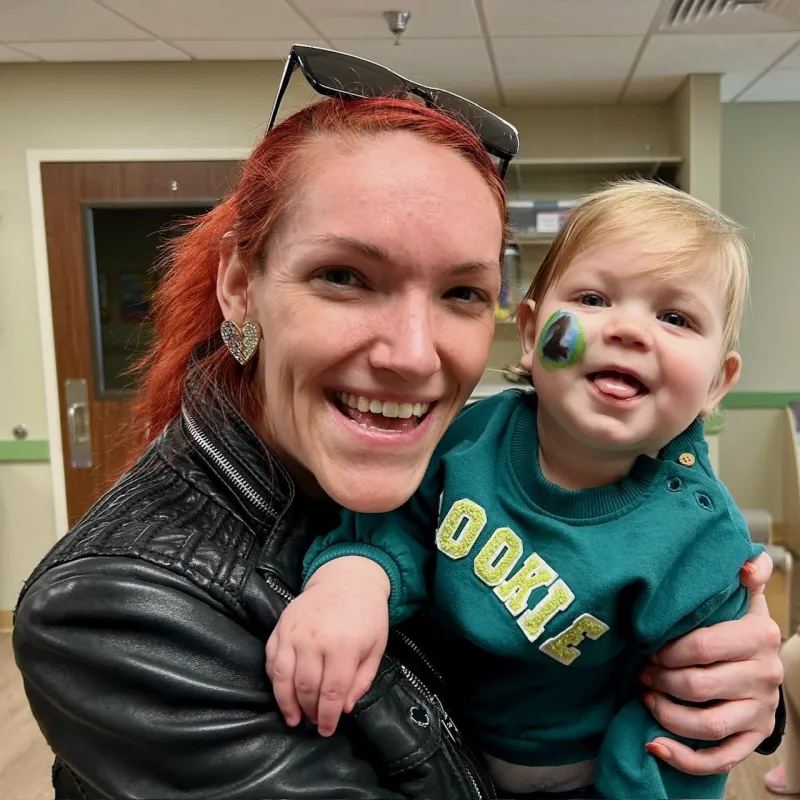
Speaking just after his first birthday, Crowder calls Clark “a little explorer” who fills their house with “jibber jabber all day long, and I love it,” she says, adding that Clark is almost walking, too. “You can tell he has the strength because he loves climbing stairs,” she says with a laugh. “He just doesn’t have the balance yet.”
She is preparing to go back to the clinic to discuss options to try for another baby.
Sharing pregnancy experience to create greater awareness, understanding
Crowder’s experience isn’t unusual, Mancuso notes. The road through infertility treatments isn’t always a straight path.
“We treat every patient as an individual,” Mancuso says. “What was unique about Courtney was how she chose to share her loss and her experience with the rest of the world.”
Crowder wrote a November 2024 article in the Des Moines Register about her experience, where she shared her grief over losing her first pregnancy.
“The magic inside me was a mirage—just as I had feared. How could I have let myself dream that this might be true? How could I have let myself hope?” she wrote. She described “sobbing “until my cheeks were raw from the wetness,” and how “the suddenness and completeness of the emptiness was itself a presence.”
She also wrote about how when she was told her pregnancy wasn’t viable, she blamed herself but was reassured by her doctor that “You are not powerful enough to have caused this problem.” She wrote that she posted this message on her wall at home and then decided to make the “active choice to let myself hope again.”
Her hope became reality through Clark.
Crowder still gets emails about that column, as more people struggling with fertility and pregnancy loss find it. She also hopes that fertility care is treated and discussed just like care for any other part of the body.
“A lot of conversations around women’s health spend so much time framing fertility as a given: Obviously, you are so fertile that you have to exercise this extreme caution,” she says. “But the real conversation needs to be about here is what’s going on in your body, here are all the possibilities, here is the reality should you want kids, and here are the interventions if that’s even a remote possibility in your mind.”
Building trusting relationships key for patients and providers
Crowder is grateful that she had the UI Health Care team at the West Des Moines clinic on her side, adding that it was enormously helpful “to have people in your corner who are like your friends,” she says.
Mancuso hopes to bring that experience to more people, too. In the fall, the West Des Moines clinic will relocate to a larger facility in nearby Urbandale, which will allow the UI Health Care team to see more patients and offer more kinds of testing and imaging in one location for all-encompassing care.
Goad says that being a reproductive care provider is a fulfilling career, even though seeing her patients experience loss can be difficult. But building close relationships with patients that enable them to share the lows also means they share the highs—like when she saw Crowder and Clark while shopping.
“To have that moment, in person—getting to see him and watch her be a new mom, telling me which pacifier to buy—was an amazing, full-circle moment for me,” Goad says with a laugh.
Patient Stories
