Specialized care and expertise in cardiothoracic anesthesia
Andrew Feider highlights the rewards of his subspecialty
Most people know that an anesthesiologist is the doctor responsible for keeping a patient sedated and comfortable during surgery.
But the anesthesiologist’s role goes far beyond administering medication. They monitor a patient’s vital signs and respond to any medical issues that arise during an operation. They have key roles before and after surgery, too — conducting preoperative evaluations, assessing a patient’s medical history and physical condition, bringing patients back to consciousness, and guiding them to postoperative care.
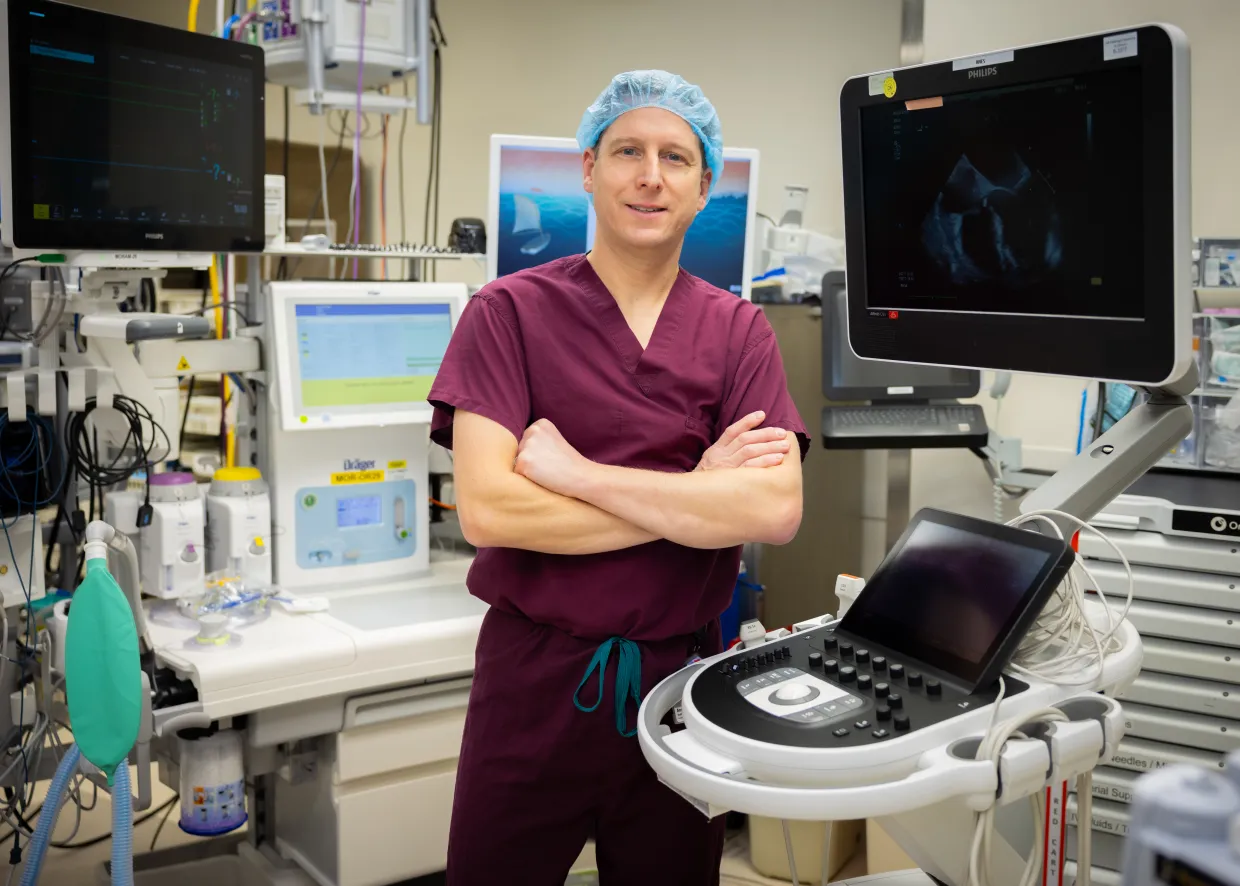
“Administering anesthesia is like piloting an aircraft,” says Andrew Feider, MD, clinical associate professor in the University of Iowa Department of Anesthesia. “If it goes well, no one notices. You’re not going to get a pat on the back every time, but knowing you’ve contributed to a patient’s care is very important.”
A key member of the cardiothoracic surgery team
As a subspecialist in cardiothoracic anesthesia, Feider is part of the cardiothoracic surgery team. He works closely with surgeons, nurses, and medical technicians who treat patients undergoing emergency surgery, heart or lung transplants, and complex cardiac procedures.
“You never know what you’re going to get,” says Feider, who serves as director of the cardiothoracic anesthesia division in the Department of Anesthesia. “You have to be adaptable but also cool and calm under pressure to get it done and take good care of the patient.”
Expertise in cardiothoracic anesthesia is not available at all hospitals. It requires extensive specialized training and a volume of cardiothoracic surgery cases typically performed at larger medical centers or academic health systems. UI Health Care is home to an Accreditation Council for Graduate Medical Education (ACGME)-accredited adult cardiothoracic anesthesia fellowship program in the Department of Anesthesia.
Specialized expertise down to a TEE
At UI Health Care, cardiothoracic anesthesiologists use transesophageal echocardiography (TEE) in virtually all open-heart surgeries. TEE is a highly specialized procedure that uses ultrasound, or sound waves, to make detailed images of the heart and the blood vessels that lead to and from it.
Here’s how TEE works: At the start of cardiac surgery, a small probe is inserted down the patient’s esophagus, where it emits ultrasonic waves to the heart. The “echoes” of these waves are sent to a computer in the operating room so that the patient’s heart function can be monitored throughout the surgery. TEE typically produces clearer images than a traditional echocardiogram, which involves a hand-operated chest probe.
Performed by fellowship-trained cardiothoracic anesthesiologists, TEE is an integral part of heart surgery at UI Health Care.
“Sometimes the case will hinge on what’s found in the TEE,” Feider says. “It’s impactful.”
Feider was drawn to the subspecialty by its unique functions, like TEE.
“In general, anesthesiologists help patients through surgery by managing their comfort and safety,” he says. “Rarely do we perform a test, make a diagnosis, share it with the team, and affect the outcome of the day. TEE is an area where we do that.”
Along with TEE, cardiothoracic anesthesiologists specialize in one-lung ventilation, which involves a special breathing tube to ventilate a single lung while the other lung is being operated on during thoracic surgery.
Contributing to research on ICU delirium
Feider is also involved in research, with a primary interest in ICU delirium — a condition that can be triggered by a patient’s post-surgical recovery in intensive care. ICU delirium symptoms involve confusion, attention difficulties, and changes in behavior such as aggression or extreme withdrawal. These symptoms can last beyond a patient’s hospital stay. Researchers don’t know all the contributing factors, Feider says, though lack of sleep is one.
“There’s not enough research out there,” he says.
Last year, UI Health Care joined a three-year, multicenter clinical study on ICU delirium. Patients enrolled in the study are given medication to help them sleep while in the ICU, in the hope that it will promote normal brain function and reduce the risk of ICU delirium. Feider is using what he’s learning in the study, along with his own clinical experience, to reconsider the medications he prescribes to patients following their surgery.
Preparing next-generation subspecialists through fellowship training
As director of the adult cardiothoracic fellowship program, Feider designs a training experience for each fellow, giving them the skills to become board-certified in advanced perioperative TEE.
Along with his research and clinical anesthesia roles, Feider says serving as the fellowship program director is one of the best parts of his job.
“If I can make a difference in the education of our fellows, and elevate them to become excellent clinicians, all the patients they take care of will benefit,” he says. “That’s an exponential contribution to patient care.”
Feider adds that as a major referral and tertiary care center, UI Health Care provides care not only for the local community and surrounding area but for the entire state, region, and beyond.
“We’re doing surgeries at this center that no one else can do in the entire state of Iowa,” he says. “We don’t shy away from that. We have an expert team that knows how to take care of these patients, and I’m proud to be a part of it.”