Interventional radiologists diagnose and treat patients using minimally invasive technologies and techniques—catheters, guide wires, needles, balloons, stents, and other devices with radiological imaging.
These procedures, which may be categorized as endo-vascular (angiography), non-vascular (e.g., decompression and drainage of obstructed kidneys and bile ducts), and interventional oncology are performed in an interventional radiology suite, often on an outpatient basis.
Many procedures that were previously performed surgically are now accomplished by an interventional radiologist with fewer risks and a shorter hospital stay. These procedures include:
Vascular malformations (lymphatic, venous, and arteriovenous malformations, and complex vascular anomalies/syndromes such as Klippel Trenauny syndrome and CLOVES)
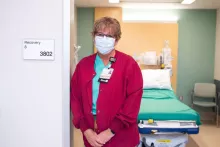
Caring for patients is a team effort on the interventional radiology unit. Susan Jeffrey-Wheeler, RN has enjoyed the two decades she’s spent in that u...