Hip preservation surgery gets North Dakota high school wrestler back on the mat
Keisha Tomac and her family looked to UI Health Care orthopedic experts to repair her hip and help her return to athletic competition.
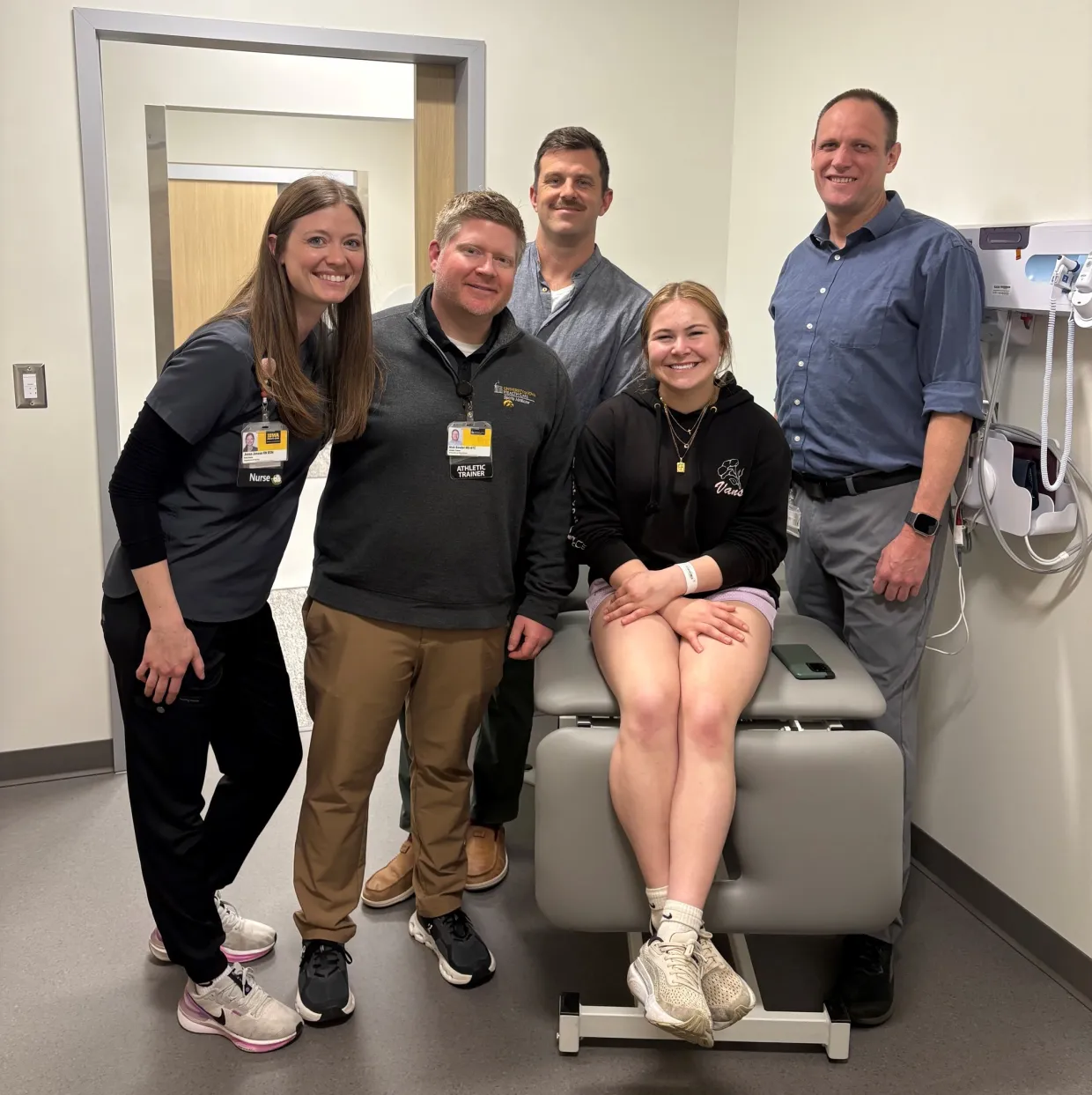
Within a year, Keisha Tomac went from a standout, three-sport freshman athlete at her high school to being lovingly called “granny” by her teammates because of her stiff, slow gait.
When months of physical therapy — and tearfully struggling through practices — didn’t relieve the pain in her right hip, Tomac visited a local orthopedic specialist, who diagnosed hip dysplasia. This is the medical term for when the ball portion of the upper thighbone does not fit properly into the hip socket.
The condition revealed itself when she ramped up her training during her teen years. A 5-foot-2-inch “spitfire,” Tomac was making a name for herself as a volleyball player, track competitor, and, especially, a wrestler, earning multiple local and state titles by her junior year.
Eager to compete at her best for the remainder of her high school career, Tomac faced surgery to repair her hip, boost her function, and give her the best chance at long-term health.
“I knew I wanted a full senior year,” she says.
Tomac and her parents, cattle ranchers living in Mandan, North Dakota, researched their options.
“I’m in the medical department of the North Dakota Army National Guard,” says her father, Waylon Tomac. “Every physician I work with said, ‘If you’re going to do anything orthopedic, go to the University of Iowa.’”
Expertise in hip preservation procedures
University of Iowa Health Care is the Midwest’s major referral center for the hip preservation surgery Tomac needed. It makes a difference when patients are treated at a center with specialized expertise in hip joint surgery, says orthopedic surgeon Robert Westermann, MD.
“You have one shot to get a hip like hers perfect,” he says.
Tomac and her father were scheduled to fly to Iowa City in March 2025 to meet the doctors who would perform her surgery. When a snowstorm delayed their flight, they returned home from the airport, hopped into the family’s four-wheel-drive vehicle, and began the 11-hour, 700-mile trip to UI Health Care’s Department of Orthopedics and Rehabilitation.
“We finally found somebody who knew how to handle Keisha’s condition,” Waylon Tomac says. “You don’t want to miss those appointments.”

Diagnosis: Hip dysplasia, impingement, and cartilage tear
Westermann and orthopedic surgeon Michael Willey, MD, clarified Tomac’s diagnosis. Along with hip dysplasia, she had hip impingement, a painful pinching that occurs when the hip bones don’t fit together and limit hip motion. Additionally, she had a labral tear, which is a cartilage tear at the front of the hip socket.
Because physical therapy and other interventions had failed, surgery was Tomac’s next move.
“She tried all the things we typically recommend before surgery, and she wasn’t able to compete, train, recover, and function at her desired level,” Westermann says. “That’s when we decided a surgical correction would be a good option.”
A former high school wrestler himself, Westermann acknowledges the struggles that injured young athletes face.
“The amount of time kids deal with these problems before they get treated can have a big pull on their mental health and their perception of themselves,” he says. “That affects kids’ well-being, especially in their developmental years.”
A two-part surgery
Tomac needed two procedures: a periacetabular osteotomy (PAO) to correct the hip dysplasia and a hip arthroscopy — a minimally invasive surgery that uses a special scope to look inside a joint — to correct the hip impingement and repair the torn cartilage.
“It was a lot to take in,” she says.
The PAO is a complex procedure in which the surgeon — Willey, in this case — repositions the hip socket through an incision in the front of the hip, securing it in place with screws. Willey trained around the world to master the procedure, which he now performs about 130 times a year.
“That’s a unique service we bring to the state of Iowa and the greater Midwest region,” Westermann says.
Westermann, who led Tomac’s hip arthroscopy, performs about 400 of those procedures annually. Patients like Tomac, who require both procedures, are rarer, though Westermann and Willey collaborate on about 65 cases a year.
“We had to treat everything in her hip for her to have the best outcome,” Westermann says. “Our thought was to do the last surgery first. That is, you correct all the anatomic factors that can lead to problems in the hip, all at the same time.”
Having the surgery as a teen decreases Tomac’s likelihood of developing arthritis or needing a hip replacement in the future, Westermann says.
Coordinated care and convenience for orthopedic surgery patients at North Liberty campus
Tomac’s surgery was scheduled for April 29, 2025, at the new UI Health Care’s North Liberty campus — one day after its opening.
The new, state-of-the-art surgical suite at North Liberty was “beautiful,” Waylon Tomac says.
More than that, Westermann says, the North Liberty campus — now home to the UI Department of Orthopedics and Rehabilitation — offers greater access and convenience for patients and families, like the Tomacs, who travel long distances.
At the North Liberty campus, the clinic is on the first floor, surgery is on the second, and recovery on the third.
“There’s better integration with physical therapy and nursing,” Westermann says. “It’s all in a centralized location, which is good for outcomes and quality.”
Learning to walk again
After her three-hour procedure, Tomac remained in the hospital for three days, recovering and starting physical therapy. She continued intensive physical therapy back home in North Dakota.
“Keisha had to learn how to walk all over again,” her father says.
Tomac used a walker for close to two months before switching to crutches. Still, she didn’t let her recovery put a cramp on her summer. She went four-wheeling in the mountains in June so she could have her senior pictures taken among the wildflowers.
Back at UI Health Care for a follow-up visit in July 2025, the doctors told Tomac she could stop using crutches. Her long-awaited return to sports, however, would take more time. Patients usually recover enough to resume athletics about six months after surgery, Westermann says.
Though she couldn’t compete in sports, Tomac stayed involved by coaching younger wrestlers and serving as manager of her track team while she healed.
“I didn’t want to just sit out,” she says. “I still wanted to be a part of the team.”
A successful return to sports
Tomac completed physical therapy by fall 2025 — a month earlier than anticipated. As captain of the volleyball team, Tomac got more playing time than expected, and the team made it to the state regionals. During wrestling season, she won multiple tournaments and placed in her state for the fifth year in a row. By the end of the season, she had offers to wrestle in college and to coach high school wrestling.
“I feel a lot better,” Tomac says. “I’m definitely thankful for where I’ve gotten and how I’ve gotten there. I’m thankful that I could play.”
Hearing about Tomac’s success on the mat is one of the best parts of the job, Westermann says.
“It’s very fulfilling to take a kid who had to miss time from their season, or is playing through pain, and perform a procedure that gives them their function back and gets them back to the sport they love,” he says.
Final follow-up visit — and a meetup with Iowa wrestling legends
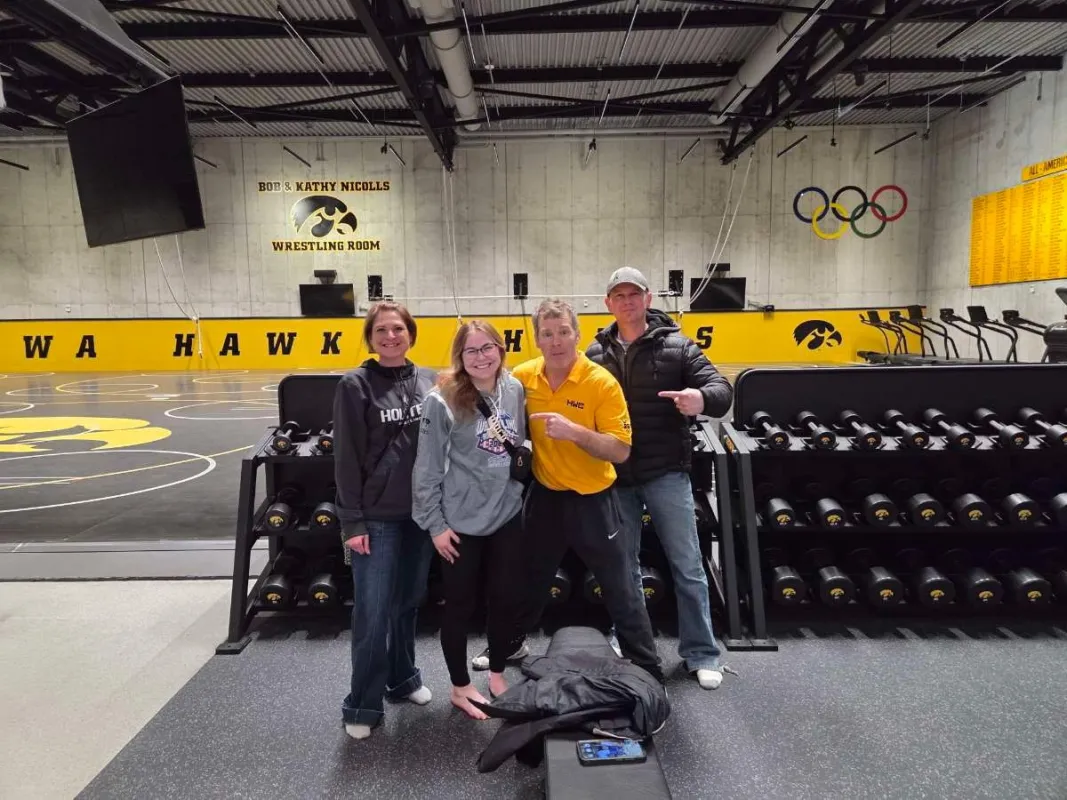
Tomac’s wrestling season, and her recovery, culminated in February 2026 with a final follow up at UI Health Care. Tomac had her screws removed, and she and her parents were given a private tour of the Iowa Hawkeyes wrestling facilities.
Waylon Tomac says the family was “starstruck” to meet Tom Brands, an Olympic gold medalist and head coach of the university’s men’s wrestling team, and to see his brother, Olympian Terry Brands, work with a Division I athlete the family had watched on TV.
Westermann, who has been head physician for the Iowa wrestling team for a decade, arranged the visit.
“Wrestlers are some of the best athletes to treat,” he says. “They have high motivation to get healthy, recover well, and have success on the mat in the future.”
Patient Stories