When should I flush my nephrostomy tube?
- Ask your care team if you should flush your nephrostomy tube.
- If you should flush your nephrostomy tube, ask how often you should flush it.
Why should I flush my nephrostomy tube?
- We want to make sure your tube does not get blocked or clogged.
How do I flush my nephrostomy tube?
To get ready:
- Get your supplies:
- 10 mL (milliliters) sterile fluid syringe(s)
- Gloves (if someone else is flushing your tube)
- Wash your hands with soap and water.
To flush your nephrostomy tube:
- Check where the tube enters your skin for any signs of infection, such as:
- Redness
- Swelling
- Drainage
- If someone else is flushing your tube, have them put on the gloves.
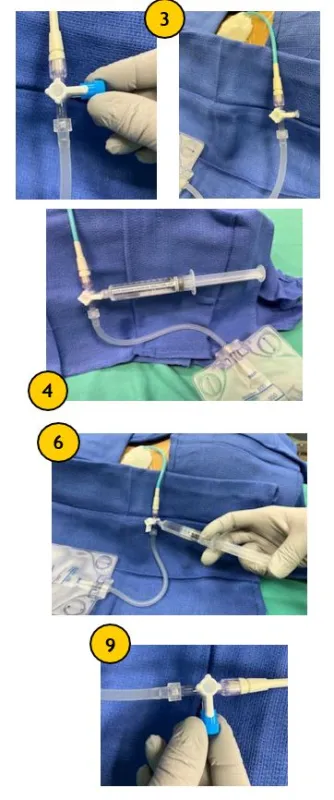
- Take the cap off the stopcock connector that is not being used.
- Connect the sterile fluid syringe to the stopcock.
- Turn the stopcock to the tubing going to your collection bag. This opens the tubing going to your body.
- Push (or called flush) 5 to 20 milliliters (mL) of sterile fluid into the tubing.
- The care team will let you know how much fluid to flush.
- Turn the stopcock back to the connector that is not being used.
- Take the syringe off.
- Put the cap back on the stopcock connector.
- Wash your hands with soap and water.
What if I have pain when flushing my nephrostomy tube?
- First, try flushing with half the amount of sterile fluid.
- If you were flushing with 10 mL, flush with only 5 mL.
- If you still have pain when flushing with less sterile fluid, check:
- If your nephrostomy tube is in place.
- If your suture (stitch) is in place.
- If your urine output (how much urine has been coming out) is normal.
- If you still have pain after checking those, stop flushing.
- If your nephrostomy tube is being replaced within 2 weeks, it is okay to not flush. Let the care team know when you come to that visit
- If your nephrostomy tube is not being replaced within 2 weeks, call the Interventional
- Radiology coordinator at 319-353-8141.
- 8:00 a.m. to 4:00 p.m., Monday to Friday
Where can I get sterile fluid syringes for flushing?
- You can buy sterile fluid syringes for flushing from the UI Health Care Discharge Pharmacy. You will need a prescription from the care team.
- Pharmacies near you may not have sterile fluid syringes for flushing. Call them to check.
- Call the Interventional Radiology coordinators at 319-353-8141.
- Monday through Friday, 8:00 a.m. to 4:00 p.m.
- You can also call toll-free at 800-777-8442.
- This is available 24 hours a day, 7 days a week.
- Ask to talk to the Interventional Radiology resident or physician assistant on-call.
- Call the Hospital Call Center at 319-384-8442.
- Ask to talk to the Interventional Radiology resident or physician assistant on-call.
- Your nephrostomy tube comes all the way out. Do not put it back in.
- You do not have any urine come out of your nephrostomy tube for 6 hours.
- Your fever or chills does not go away after taking antibiotic medicine prescribed by your care team.
- Bright red blood in your urine
- Chills
- Fever of 101.0° Fahrenheit (38.0° Celsius) or higher
- Severe pain
- Your nephrostomy tube comes part of the way out and is not working (no urine is coming out for 2 to 3 hours)
- You have less urine output (how much you are peeing) than normal for 12 or more hours.
- Your urine is starting to look red.
- Your urine stays a different color than normal for 12 or more hours.
- Your urine is starting to smell bad.
- Your urine does not get lighter in color with drinking water.
- You have skin redness or pus draining from or around your nephrostomy tube.
- You have a skin or connection leak.
- You cannot flush your tube (if you have been told to do so) and it is not being replaced within 2 weeks.
- Your suture is loose or falls out and your tube is not being replaced within 2 weeks.
- You have pain that pain medicine does not help.
- You have questions about your drain.
- You need to change or reschedule your next visit.
- Your urine may be light yellow to dark yellow or orange.
- Watch the color of your urine so you know if you have a change in your urine color.
- We may ask if you are drinking more or less water than usual.
- We may ask if you ate any food you do not normally eat. Some foods can change the color of urine.
- We may ask if you took any medicine you do not normally take.