Engineering a better way to explain scoliosis care
Working alongside experts at UI Health Care, biomedical engineering students turned a classroom project into a teaching tool that’s now helping young patients understand scoliosis treatment.
A scoliosis brace can often help a young person avoid surgery.
But only if it’s worn.
For many young patients, that means wearing a rigid plastic brace for up to 16 hours a day over the course of two to three years — a difficult commitment for adolescents already navigating school, activities, and concerns about body image.
“A scoliosis diagnosis itself can be a bit frightening,” says Stuart Weinstein, MD, a pediatric orthopedic surgeon at University of Iowa Health Care Stead Family Children’s Hospital. “Then you tell them the treatment is a brace, which can look intimidating. They start to wonder, ‘How is this actually going to work?’”
A team of University of Iowa biomedical engineering students set out to answer that question — not with another brochure or diagram but with an interactive teaching tool designed specifically for children and teens with scoliosis.
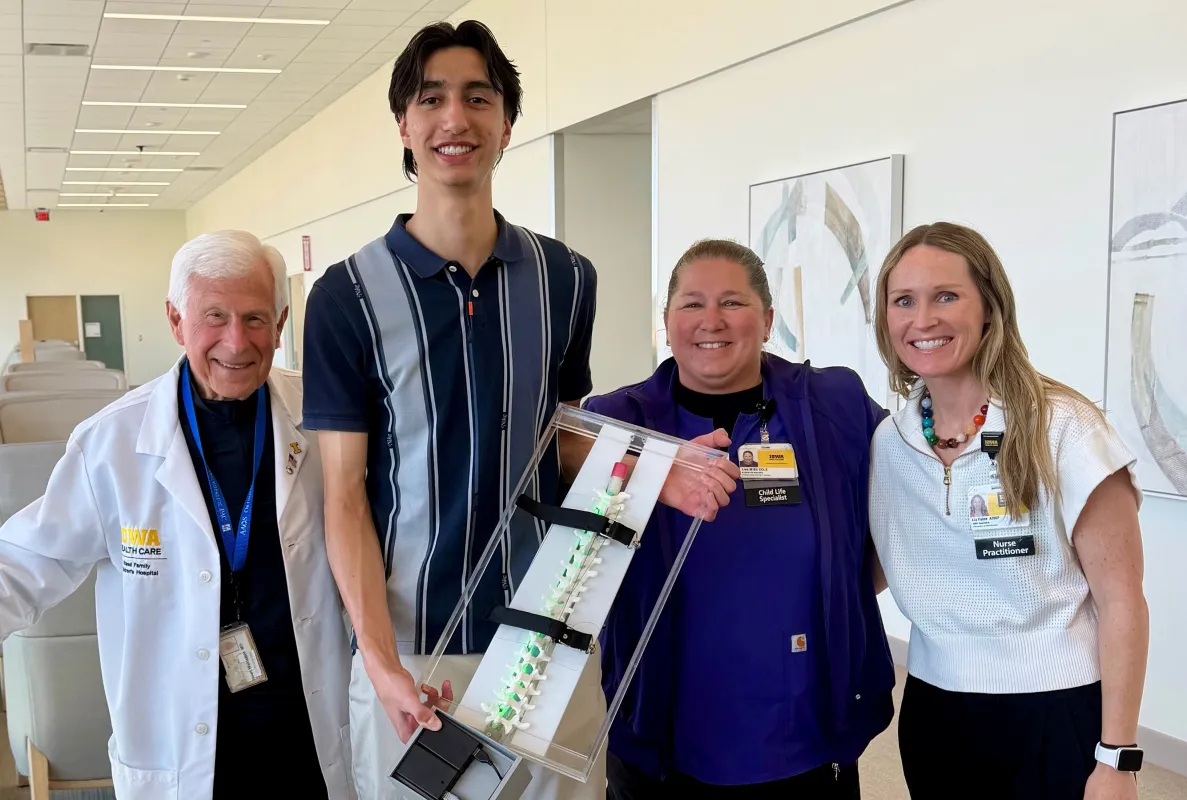
Working alongside Weinstein and his team, child life specialists, and hospital epidemiology experts, the students built a spine model that demonstrates how a thoracolumbosacral orthosis (TLSO) brace helps guide spinal growth. When the model’s curved spine is uncorrected, it glows red. As the brace is tightened and the spine moves into better alignment, the light changes to green.
“The model beautifully shows kids what the brace actually does,” Weinstein says. “It’s visual feedback of what we’re trying to achieve. We’re trying to get teenagers’ buy-in, and it helps them understand how the brace works and why wearing it correctly matters.”
Today, the teaching tool is being used in the pediatric spine clinic, giving families a hands-on way to better understand treatment — and giving biomedical engineering students a firsthand lesson in designing for real-world health care.
A classroom project with real patients in mind
The idea began with a practical problem.
For years, the spine clinic had used a stuffed giraffe containing a flexible spine to help explain scoliosis to children. The model helped patients visualize their condition, but evolving infection-prevention standards meant the fabric teaching tool could no longer be used in the clinical environment because it couldn’t be easily disinfected between patients.
Lisa Miguel, a senior child life specialist and Child Life Joint Commission Team lead, was asked to help identify a replacement in summer 2025.
The timing was perfect.
Biomedical engineering fourth-year students Aiden Dogic and Max Casini, who worked with Miguel as student assistants in the Child Life Program at Stead Family Children’s Hospital, were looking for a senior design project.
“I overheard her talking about needing to replace this teaching tool,” Dogic says. “I sort of budged in and said, ‘We have a senior design project coming up. What if we helped you with it?’”
Dogic, Casini, and fellow students Ronan Peach and Grace Wohnoutka pitched the idea to faculty members, who approved the project as their yearlong senior design experience.
“We all especially liked that the project was pediatric focused and that we got to basically make a toy,” Dogic says. “And we got to work with a world-renowned doctor and his team, which was awesome.”
Learning what it really means to design for health care
The students soon discovered that creating a useful medical device involves much more than engineering.
“It was about creating something that’s engaging, developmentally appropriate, fully cleanable, and something clinicians can use with patients,” Miguel says.
Working with Weinstein, Miguel, nurse practitioner Elizabeth Faine, and infection prevention control professional Oluchi Abosi, the team had to balance patient education, usability, infection prevention, available resources, and engineering design.
“It definitely changed how we approached the project,” Casini says. “Everyone had different requirements, and we had to come up with a solution that satisfied all of them.”
One of the biggest challenges was making every component cleanable.
After presenting an early prototype to Abosi, the students received detailed feedback about eliminating crevices, sealing porous 3D-printed surfaces, and selecting hospital-approved materials.
They responded by redesigning the model with smooth surfaces, resin-coated components, and materials that could withstand the hospital's cleaning process.
For Dogic, the experience revealed how collaborative medical innovation really is.
“We had to work with epidemiology, child life, the nurse practitioner, the surgeon, medical instruments, and our faculty,” he says. “There are a lot more people involved than just engineers building something.”
Scoliosis is a condition in which the spine, or backbone, has an abnormal sideways curve.
- 2% to 3% of people worldwide have scoliosis.
- Idiopathic scoliosis — the most common form and for which there is no known cause — is most often diagnosed between the ages of 10 and 15.
- 97% of people who have scoliosis will never need treatment. Of the 3% who do need treatment, very few will need surgery.
- Back braces prevent the need for spinal correction surgery in 90% of patients with scoliosis who need treatment.
The University of Iowa has been a center of excellence in clinical care and research in the diagnosis and management of spinal deformity since 1976. If you have scoliosis, the team at University of Iowa Health Care and Stead Family Children’s Hospital is the most experienced in the state, offering a range of treatment options customized to meet every patient’s needs.

Helping children see how a brace works
The finished device demonstrates both scoliosis and its treatment. Users can manipulate the model’s curved spine while placing a removable brace around the torso. Weinstein says the model’s visual explanation — indicator lights changing from red to green — is invaluable.
“Scoliosis braces don’t correct a curve by pulling directly on bone the way braces move teeth,” says Weinstein, who has spent decades studying scoliosis treatment. “Instead, they apply carefully directed pressure that helps guide spinal growth over time, reducing the likelihood that a child will eventually need surgery.”
Weinstein helped lead a landmark study that proved bracing can successfully prevent surgery for many patients with scoliosis.
But buy-in from the patients is crucial.
Teenagers diagnosed with scoliosis are often asked to wear a brace for an average of two and a half years. Because treatment depends heavily on wearing the brace consistently, helping patients understand why it works can improve adherence to the plan.
“Our goal was to create a developmentally appropriate teaching tool specifically tailored to adolescents that was interactive, engaging and educational,” Miguel says. “Kids are tech savvy. They want the lights and whistles. They want to see exactly what’s happening. And at the end of the day, our students created a device that was just that. It’s exciting. It gives them immediate results they can actually visualize.”
The model is now used when new patients receive their braces and is also available for child life specialists helping prepare children for scoliosis treatment.
Lessons beyond engineering
All four students graduated in May with degrees in biomedical engineering. Although Casini and Dogic plan to attend medical school rather than pursue engineering careers, they say the project changed how they think about patient care.
Dogic says building the teaching tool reinforced that effective communication can be just as important as medical knowledge.
“I realized there’s such a need for educational resources that help patients understand what’s happening,” Dogic says. “Something that’s tangible and easy to visualize helps clear confusion and fear in the treatment process. I will carry forward the lesson that effective communication is just as vital as clinical expertise, and I hope to apply that principle throughout my own career in patient care.”
Casini came away with a new appreciation for interdisciplinary teamwork — and for the real impact seemingly small innovations can have.
After completing the project, both students shadowed Weinstein in clinic, where they witnessed conversations with the families of patients whose scoliosis had progressed to the point that surgery was necessary.
Seeing those discussions underscored why helping patients successfully use a brace matters.
“Our goal was to help patients avoid scoliosis surgery,” Casini says. “Seeing those conversations made the purpose of our device feel even more meaningful.”
Casini and Dogic both say the project strengthened their motivation to become doctors.
“This work definitely influenced how I will approach the profession,” Casini says. “I know that as a future doctor, if I run into issues that I think can be solved, I can use my own biomedical engineering skills or reach out to others to help create solutions, and I think that is very powerful.”
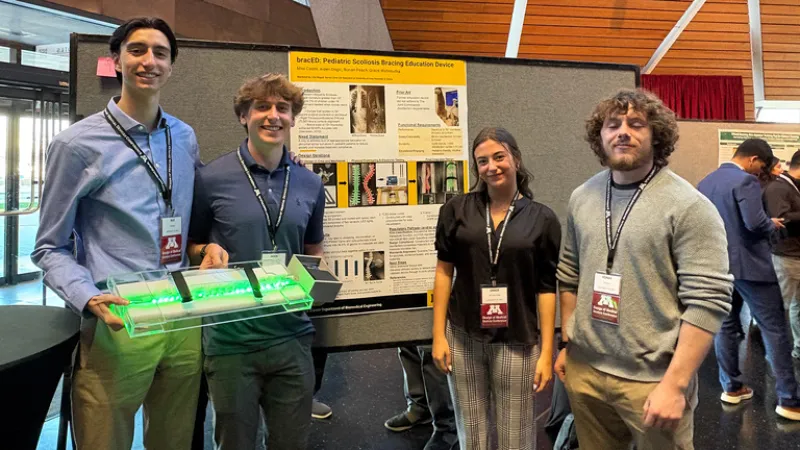
The work of the four recent biomedical engineering grads earned recognition beyond the University of Iowa.
Max Casini, Aiden Dogic, Ronan Peach, and Grace Wohnoutka were selected to present at a national medical device conference — one of just 18 undergraduate teams nationwide to receive an invite.
“It was a really cool opportunity for us,” Casini says. “We weren’t expecting all this recognition, but it’s been nice. We were just trying to develop a good product for Dr. Weinstein’s team and his patients.”
The team wasn’t the only University of Iowa group to present at the Design of Medical Devices Conference.
Atif Qureshi, Ethan Ranft, and Julien Barsch won third place in the Student Design Showcase for their Secure Nasogastric Unit for Growth (S.N.U.G.), a device designed to reduce nasogastric tube migration and accidental removal in preterm neonates.
Brianna Cannoy, Carmen Didelot, Kate Pavletich and Kristen Strathman presented their Mepilex Integrated Pressure Detection Device, which focuses on detecting and preventing hospital acquired pressure injuries, specifically on the heel.
Learning goes both ways
For Weinstein, the project demonstrates the value of bringing students into real clinical settings.
“Being part of a major university gives us opportunities like this,” he says. “It's so nice to work with enthusiastic students who want to be there, who want to be doing something. They were totally engaged and excited. Their enthusiasm and excitement were infectious, and we all felt it.”
Miguel agrees.
“This collaboration is invaluable,” Miguel says. “Innovation in health care thrives on collaboration. If we are not continuously learning and evolving, we fail to deliver the standard of care our patients deserve. The mutual exchange of knowledge throughout this partnership has been incredibly rewarding.”
The project also presented a full circle moment for Dogic.
“When the new hospital in North Liberty was being built, I helped install some of the medical machines,” Dogic says. “It’s cool to know that I actually made something in there that they use now.”