<2%
patients requiring a more invasive surgery afterwards
After years of monitoring a leaky heart valve, worsening fatigue led one Iowa man to surgery. At UI Health Care, a minimally invasive approach helped him recover faster and get back to daily life.

For years, John Yoder of Iowa City stayed active. He worked full-time in agricultural equipment sales, managed a team, and spent time with his six grandkids. He enjoyed golfing and kayaking.
“I like to move,” he says. “I don’t sit still very long.”
But in December 2021, during a routine annual physical, his primary care provider noticed a heart murmur. At the time, it didn’t seem urgent.
Over the next few years, Yoder had regular echocardiograms. They showed mild to moderate mitral valve regurgitation, a condition where the valve between the left heart chambers doesn't close fully. But something was changing.
“It was quietly sneaking up on me,” he says.
Each year, he felt more fatigued.
“I noticed I was just feeling a little bit more exhausted, a little bit more tired, and couldn’t quite do what I used to do before,” Yoder says.
He assumed it was all just part of getting older.
“I blamed it on old age,” he says. “I was 64 years old at this point, and I assumed this is what I was supposed to feel like.”
In July 2025, that changed. His condition progressed to moderate to severe mitral valve regurgitation. Further testing confirmed the need for surgical evaluation.
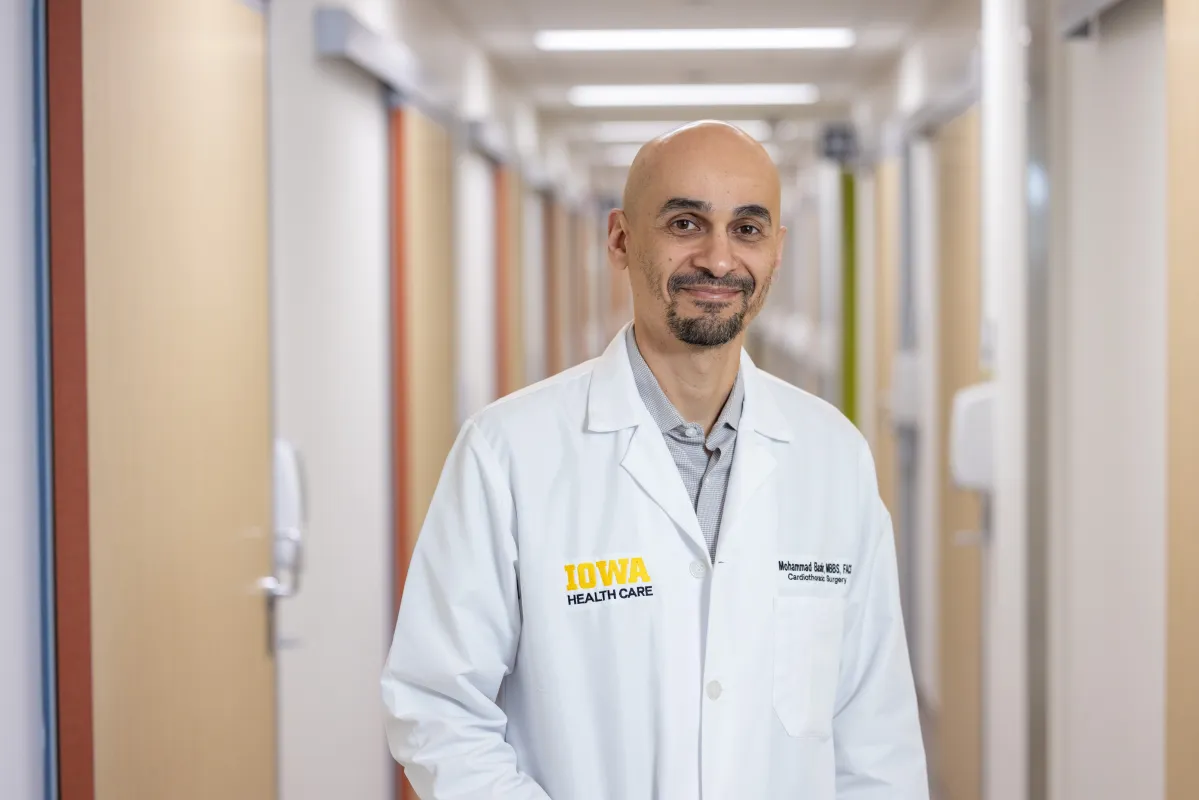
Yoder was referred to Mohammad Bashir, MBBS, a cardiothoracic surgeon at University of Iowa Health Care.
After additional testing, Bashir walked him through every option — including repair versus replacement. That clarity meant a lot to Yoder.
“I felt like everybody was 100% listening to what I had to say,” he says.
Bashir recommended a minimally invasive mitral valve repair — a procedure that fixes a leaky heart valve using small incisions instead of opening the chest. Many patients, he explains, are candidates for this approach. In Yoder's case, repair was possible because of the condition of his valve.
“He had a degenerative valve that didn’t have much calcium, so his valve could be treated with a repair,” Bashir says.
Bashir also made sure Yoder understood that a more invasive open approach could still be needed if repair wasn’t possible with the minimally invasive procedure.
“We tell every patient who is going to have minimally invasive surgery that open heart surgery is still a possibility,” Bashir says.
However, he notes that fewer than 2% of all patients who undergo the minimally invasive valve surgery actually require a more invasive surgery afterwards.
Minimally invasive mitral valve surgery avoids the large incision used in traditional open-heart surgery. It involves smaller incisions, using a camera.
The goal is the same — but the approach is different.
“Basically, we perform the same operation that’s done through a large incision but through small holes that heal very quickly,” Bashir says.
“You can return to your daily life in a very short period of time,” Bashir says. “Within four to six weeks, most people have recovered and are back to their work or regular activities.”
But Bashir emphasizes that minimally invasive surgery is not the easier option for the surgical team.
“It does take extra training and extra time on the physician’s part and the rest of the team to be able to get good outcomes,” he says.
That level of experience is part of what sets the program apart at UI Health Care.
“All of our team members can perform the minimally invasive surgery rather than just one or two people,” Bashir says.
He notes UI Health Care is the busiest minimally invasive program in Iowa and the most robust minimally invasive program in Iowa for heart surgeries of all types.

If you’ve been told you may need mitral valve repair — or symptoms like fatigue or shortness of breath are getting worse — a second opinion can help you understand whether minimally invasive surgery may be an option.
For Yoder, the decision came down to confidence in the team.
“I felt like I was in the right place, with the right people in charge,” he says.
He had done his research — on the procedure, the hospital, and on his surgeon. He moved forward with surgery, which he underwent in February 2026.
Soon after surgery, he learned the repair had worked. What stood out to him most was the care team.
“They made me feel at home right away,” he says.
He also valued having direct access to support after going home.
“I was able to pick up the phone and talk to somebody that helped me through the process,” he says.
Yoder was discharged days later. Within weeks, he could tell his recovery was moving in the right direction.
After six weeks, the difference was noticeable. By eight weeks, he says, “I was ready to hit the road running as hard as I can."
He officially returned to work without restrictions by April.
Today, the impact is clear.
“It’s a night-and-day difference,” he says. “I can put in a full day and not be exhausted. I breathe better. I just function better.”
He’s continuing cardiac rehab and preparing to return to activities like golf and kayaking.
“I feel at peace with myself,” he says. “I feel like everything is fixed, and we’re good.”
Looking back, his biggest takeaway is how easy it is to overlook symptoms like fatigue, reduced stamina, and shortness of breath.
Bashir sees this often.
“Most people attribute their symptoms to their age,” he says.
That’s why regular checkups matter — and why worsening symptoms shouldn’t be ignored.


For patients facing valve surgery, understanding all options is critical.
That includes whether a minimally invasive approach is possible. You may want to ask a about a second opinion if you’ve been told you need valve surgery, if your symptoms are getting worse, or if you want to know whether a minimally invasive approach may be an option.
“Seeking an experienced center with these kinds of approaches is important,” Bashir says.
For Yoder, that made all the difference.
“Listen to your doctor,” he says. “If the doctor doesn’t like what he sees, do something about it. It’s a lot easier to fix it early than it is to wait until it’s too late.”