AirCare Emergency Transport
AirCare Emergency Transport
When every second counts, AirCare, provided by University of Iowa Health Care and Air Methods, delivers expert emergency medical care. As Iowa’s first and longest-serving emergency helicopter service, AirCare provides rapid transport for critically ill and severely injured patients, including neonates, children, and adults with complex or time-sensitive conditions.
Our fleet of helicopters and specialty transport ground ambulances are staffed by highly trained medical professionals who deliver life-saving care enroute and operate 24/7. We adhere to the highest standards of safety and quality, as recognized by our Commission on Accreditation of Medical Transport Systems (CAMTS) accreditation.
AirCare is an extension of UI Health Care’s commitment to excellence. Our research and clinical expertise help shape the future of critical care.

Request AirCare Emergency Transport
Facts, figures, and features
- Serving since April 1, 1979
- Iowa’s first hospital-based air medical program and one of the first 15 in the U.S.
- 4.6 million miles flown and 43,000+ patients served (as of spring 2026)
- First Iowa flight program affiliated with an emergency medicine residency training program
- First in Iowa to earn CAMTS accreditation for air medical excellence
What sets AirCare Apart
AirCare delivers more than transport. We bring cutting-edge critical care directly to the patient. Here’s what sets us apart:
- Every AirCare flight carries life-saving red blood cells and plasma. Research shows that trauma patients have significantly better survival rates when they receive blood immediately. In cases of severe injury, hemorrhage can lead to shock and organ failure, making rapid blood replacement vital. Our staff are trained to administer blood at the scene or in-flight, which also supports hospitals facing blood shortages.
- We use 3% saline to stabilize traumatic brain injuries. Our crews receive specialized training in the safe handling and administration of this critical fluid—providing the highest level of care in the most urgent situations.
- Our teams are trained to manage Impella. Impella is a ventricular assist device used to support patients with severely depressed heart function. While referring hospitals initiate the device, AirCare crews are trained to monitor and adjust it during transport.
- Our teams can transport patients on ECMO. For patients requiring extracorporeal membrane oxygenation (ECMO), we bring both the specialist and the equipment directly to the referring facility. This allows us to stabilize and transport even the most complex cases.
- We have a dedicated neonatal transport team. This team specializes in the safe transfer of premature and critically ill infants to UI Health Care Stead Family Children’s Hospital—home to the only Level 4 NICU in Iowa—so that the tiniest patients receive the most advanced care from the start.
- We offer advanced intra-aortic balloon pump (IABP) transport capabilities. IABPs are devices that help support blood flow from the heart and are often used by patients who have recently had surgery or a cardiac event. During transport, our flight teams are specially trained to continue a patient’s existing IABP support.
Unmatched clinical quality
Our team consists of highly trained professionals with advanced critical care expertise. Each flight includes a flight nurse and paramedic, both with at least three years of experience in critical care or emergency medicine. Many missions also feature physicians specializing in surgical and medical ICU, burn ICU, NICU, PICU, emergency medicine, and EMS.
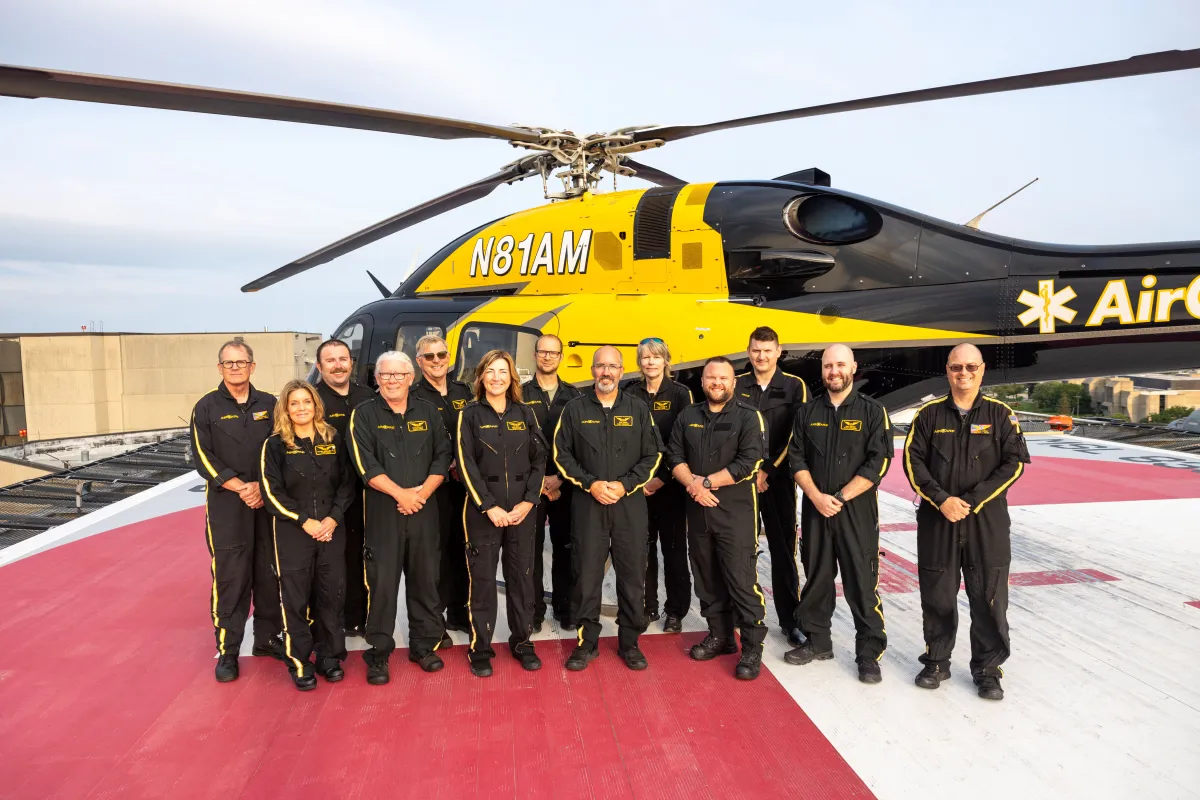
We prioritize continuous development through education, simulation training, and case reviews. Staff engage in monthly critical care education and contribute to federally and institutionally funded research shaping emergency medicine.
Our quality improvement program regularly updates treatment protocols based on the latest evidence, distinguishing us nationally for innovation and evidence-based care.
Every flight benefits from indirect physician oversight and real-time online medical control. Our medical director, a practicing EMS physician, leads protocol development and quality assurance to uphold the highest standards of care.
Ground safety educational opportunities
AirCare offers classroom education for emergency medical services and hospitals, including continuing education hours and helicopter fly-in for the following situations:
- Toxicology
- Trauma
- Pediatric respiratory emergencies
- Environmental (hypothermia/hyperthermia)
- Newborn resuscitation/OB emergencies
- Cardiovascular emergencies
- GI emergencies
- Neurology
- Airway/RSI
- START and JumpSTART MCI triage
- Landing zone training
- Helipad safety training for referring hospitals
CAMTS accreditation provides evidence-based standards and guidelines so that every aspect of our program meets or exceeds national benchmarks for quality, safety, and clinical care.
CAMTS also supports continuous improvement by maintaining a national database of helicopter EMS services. This allows us to track and compare quality metrics. All AirCare staff are required to achieve the highest levels of certification in prehospital and interfacility medicine within two years of hire. This includes certifications such as Certified Flight Registered Nurse (CFRN) and Certified Flight Paramedic (FP-C).
Air Methods provides aviation, fuel, maintenance, aircraft, dispatch, and billing, while UI Health Care provides medical staffing and medical direction for its AirCare program.
Air Methods is dedicated to emergency air medical transport, focusing on patient quality of care and safety in aviation. Air Methods delivers lifesaving care to more than 100,000 patients per year and only responds when a physician or a first-responder calls.
Patient Stories