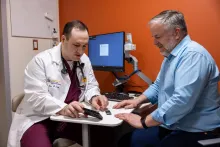
Should you consider Afib ablation early?
If you have Afib, the answer may be yes. Newer evidence suggests that discussing ablation earlier, rather than waiting years, may help reduce Afib progression and lower long-term risks such as stroke, heart failure, hospitalization, and death.

For many patients, yes, you should consider Afib ablation earlier.
Atrial fibrillation, or Afib, is the most common type of arrhythmia, or irregular heartbeat. It starts in the upper chambers of the heart and can lead to an abnormally fast, slow, or inconsistent rhythm over time.
If you have Afib, it may be worth asking about ablation sooner rather than later, especially if your symptoms come back, medication is not working well, or you want to understand your options before Afib progresses.
Afib ablation is a type of cardiac ablation, a minimally invasive procedure that uses targeted energy to create small scars in the heart. These scars help block the abnormal electrical signals that cause atrial fibrillation.
“We have a lot of recent evidence that there is no need to wait several months or years,” says Sergio Conti, MD, a cardiac electrophysiologist at UI Health Care.
Afib is a progressive disease, which means it gets worse over time. That is why the earlier Afib is evaluated and treated, the better the chance of lowering the risk of serious complications down the road.
Why earlier treatment may matter
Afib is not just a rhythm issue. Over time, it can raise the risk of serious health problems.
“The first and biggest risk is stroke,” Conti says. “People who are not treated for Afib, or people who don’t even know they have Afib, can have a serious increased risk of stroke.”
He notes that a fast and irregular heart rhythm can lead to heart failure as well as longer-term cognitive concerns.
“We have some new evidence that Afib can lead to an increased risk of dementia at some point down the road,” Conti says.
In other words, ablation is not only about treating Afib symptoms. It is also about reducing long-term risks.
What the latest evidence shows about early ablation
Recent research continues to support the idea that timing matters.
In a study published in 2025 in the Heart Rhythm journal, involving more than 16,000 patients, those who had ablation within one year of diagnosis had better long-term outcomes than those who waited longer.
- Afib recurrence was lower (41.3% vs. 50.9%)
- Heart failure exacerbation was reduced
- Ischemic stroke risk was lower
- Hospitalizations were reduced
- Mortality rate was lower
“If we do a procedure in an early stage of Afib, we can stop the progression of Afib, and we can also reduce the amount of time that the people spend in Afib,” Conti says. “By reducing the amount of time that people spend in Afib, we reduce the risk of stroke, heart failure, dementia, and mortality.”

Wondering if Afib ablation is right for you?
An earlier conversation with an electrophysiology specialist may help you understand your options before Afib progresses.
When it may be time to move beyond medication
Medication is often the first step in treating Afib, especially after an initial episode. But it is not always a long-term solution. Over time, medication treatment of Afib can become less effective or harder for you to tolerate.
Medication options can also be limited. Some can cause complications in patients who have heart failure, and others can cause complications in patients who have thyroid disease or lung disease.
“Medication may be effective at an early stage to treat and reduce the episode and the frequency of the Afib, but in the long term, since it’s a progressive disease, medication may not be effective,” Conti says. If medication is not effective or not tolerated by the patient, the next best step is an ablation procedure. If the ablation is effective, most patients can stop taking Afib medication, Conti notes.
Who should ask about an early-stage ablation?
Not every patient will follow the same timeline, but some groups may benefit from earlier referral to an electrophysiologist.
“If you are younger, active, can’t tolerate medication, or don’t want to take medication, you may benefit from ablation in an early stage,” Conti says.
Just as important, some patients wait too long because they assume Afib can be managed passively.
“There’s still the idea that it’s something that you can just leave and wait to see if the problem comes back,” Conti says. “Don’t wait. If the problem comes back a second or third time, you should consider getting an ablation.”
What to expect from Afib ablation
At UI Health Care, Afib ablation starts with a full evaluation.
“Usually our workflow is pretty standard,” Conti explains. “We see you in clinic, we evaluate, and run any necessary tests. Then, we schedule the ablation.”
Ablation is an outpatient procedure, and patients typically go home the same day.
Recovery is often quick.
“If everything goes well, you can go back to work within three to five days, according to your physical activity,” Conti says.
One of the most common concerns about ablation is safety. Many patients assume the risks are higher than they actually are.
“There is between 2% and 2.5% risk of any complication of Afib ablation,” Conti says.
The chance of experiencing any serious complications — such as having a stroke during the procedure — are even less common, less than 0.5%, according to Conti.
Acting earlier can change the course of Afib
What matters most is understanding where you are in the course of Afib — and not waiting too long to act.
The timing of treatment can influence how effective treatment is and what your long-term risks look like.
An earlier evaluation can help you understand your options, including whether ablation should be considered before Afib has more time to progress.