Q&A: Keith Michael
Spine surgeon among a new group of faculty joining the UI Department of Orthopedics and Rehabilitation
Anyone familiar with the film Field of Dreams can finish the iconic “If you build it ...” line.
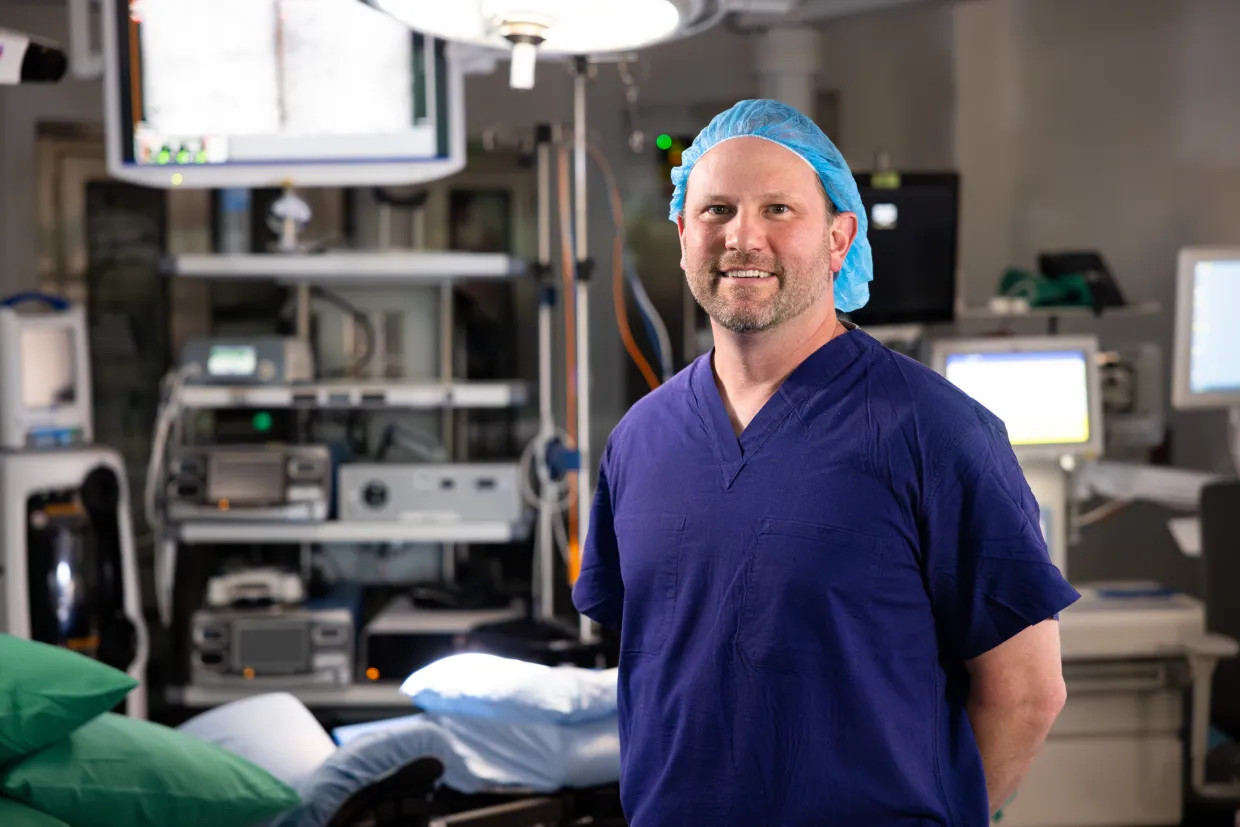
For spine surgeon Keith Michael, MD, the phrase now may carry special meaning.
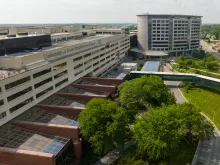
Since the spring 2025 opening of University of Iowa Health Care’s North Liberty campus, Michael is one of several faculty members to join the Department of Orthopedics and Rehabilitation. And while operating in a state-of-the-art facility — with the full scope of orthopedic clinical, surgical, and rehab services in one location — was a key selling point, the prospect of leading and developing a burgeoning spine surgery program ultimately brought Michael to Iowa after 12 years at Emory University Medical Center in Atlanta.
“When I saw the opportunity to work in this still-new building and be part of a young spine division, I knew it was a chance to really contribute to the department through education and training and efficient, personalized care,” Michael says. “Most orthopedics departments at academic centers don’t have this kind of facility in place.”
Michael, who is also director of the department’s fellowship training program in orthopedic spine surgery, discusses coming to Iowa, general misperceptions about spine surgery, and building the program’s reputation around the patient experience.
Having been at Emory for over a decade, what made you seriously consider leaving Atlanta for the Midwest?
Iowa has a very storied history in the orthopedics training world. Actually, I interviewed here as a medical student for residency training before matching at Duke. I thought Iowa was one of the best places in terms of the breadth of training but also the maturity of the trainees when they graduated. That was always in the back of my mind.
Emory has a great ortho residency, but what they’re really known for is their spine fellowship program. I did my fellowship there and then went back to Duke. A couple of years later, Emory asked if I’d be interested in joining them.
After some time at Emory, I got to where I was leading the spine division and the fellowship program, and I worked with some incredible fellows along the way. One of whom is Josh Eisenberg (MD, 24R), who is one of our spine specialists here at Iowa. We had stayed in touch since he’d completed his fellowship, and he told me so many great things about the opening of the North Liberty campus. The more I thought about it, the more I realized that what makes work enjoyable and impactful is when you’re working with like-minded people to accomplish a mission.
Eventually, my wife and I came up to visit Josh and his wife. He gave me a Saturday tour of the facility — under the radar, long before any conversations with anyone about possibly making a move. And I was mind-blown, quite honestly.
Now that you’ve been here for several months, what should patients and referring providers know about the spine surgery program at Iowa?
I would start with the premise that, in general, spine surgery has traditionally not enjoyed a stellar reputation. If you talk to friends or neighbors who’ve had hip or knee replacements or ACL reconstructions, many of them would say, “It was great. Changed my life. I’m walking so much better.” And for a lot of reasons, spine surgery is not something people are excited to go through. I’d argue that sometimes patients aren’t getting the right surgery at the right time. And yet, there are actually a lot of satisfied patients where spine surgery had a tremendously positive impact. But there’s a perception problem.
Among patients?
I’ll give you an example: Less than a year ago, I worked with a young female athlete in Georgia, a collegiate basketball player. She had an ongoing back problem, one in which a spinal fusion procedure could radically change her life and get her back to playing her sport. But she had been told, “Never, ever, have a back surgery.” Her parents told her this; her friends told her this; her trainer told her this.
We discussed her problem, and by the end she understood that, in her case, surgery could help her get back to playing in six months. Two months after we’d met, she had spine surgery, and she is back to playing basketball. She is a success story, but it all started because of a conversation about what spine surgery realistically could do and could not do.
I love meeting patients early on, where we can say: Look, there is a whole gamut of choice. We may start you with physical therapy or lifestyle changes. We may send you to someone for injections. And it may be six months — or six years — before you decide to do spine surgery, but at least you will have a better understanding of the specific nature of your problem and the right surgical or nonsurgical approach.
What broader goals or opportunities do you see for the orthopedic spine surgery program?
As a tertiary health system and the state’s academic medical center, we have a responsibility to take care of all Iowans. That’s not going to change. We’re never going to cherry-pick the easiest cases or the fastest, highest-paying surgeries.
But we have an opportunity to change the philosophy behind spine surgery, as I’d mentioned. Patient education and understanding are so important to achieving a positive outcome.
I’m typically more excited by good patient satisfaction scores than volumes because that’s how you grow and take care of people. That’s what I hope to imprint here. I would consider success to be that we grow in volume by treating patients who choose to come here in addition to those who need to come here. In other words, we base our reputation around the patient’s experience. I think our orthopedics team here at Iowa has that attitude. I think the facilities provide that opportunity. It’s incumbent on us to stay committed to that.
And if in five or 10 years from now, we’ve added more one or two more spine surgeons, we have two spine fellows, and we have nation-leading patient satisfaction scores, I’d say we’re doing the right things and we’re successful. That’s what I care about.