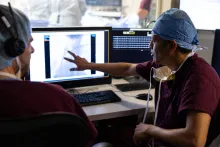
How critical care teams saved the life of a nurse’s stepson
Carol Haugen shares how team-based, compassionate care helped support her stepson’s recovery and made a lasting impact on their family.
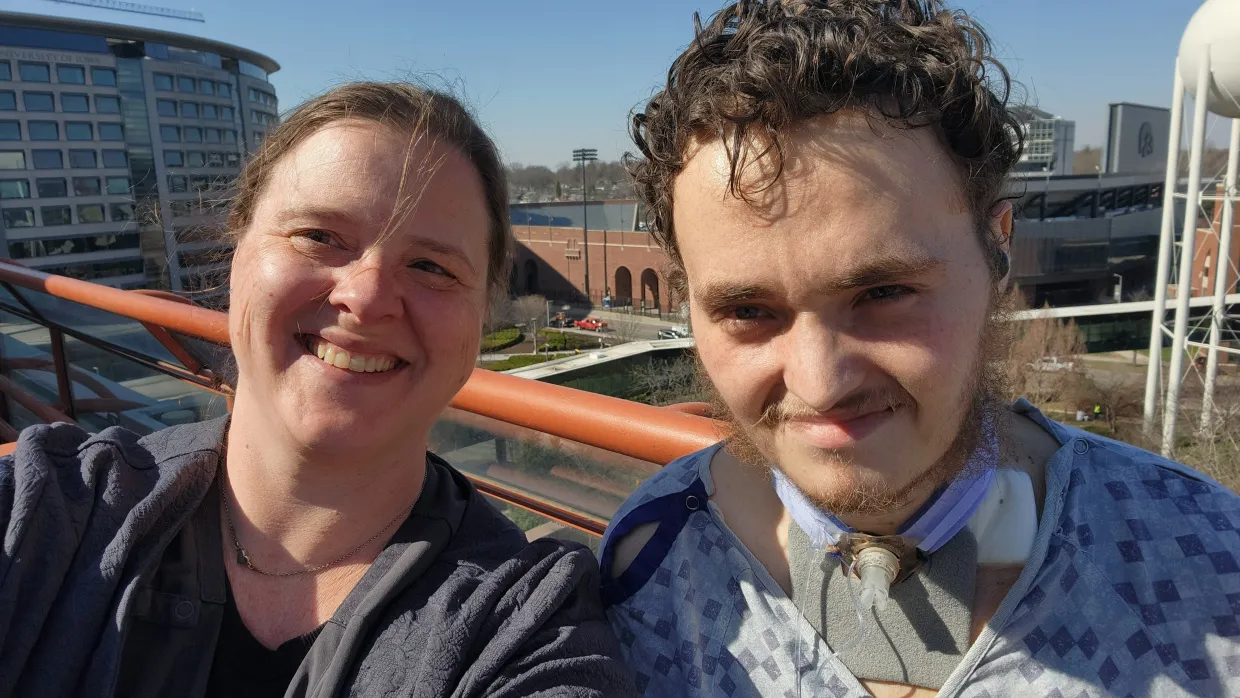
Carol Haugen, BSN, RN, has spent her career supporting patients and families through some of their most difficult moments as an assistant nurse manager. But when her stepson, Tevin Haugen, became critically ill earlier this year, she found herself on the other side of health care, relying on colleagues' compassion and expertise while facing an uncertain future.
Tevin, 25, of Muscatine, Iowa, was admitted to UI Health Care’s Medical Intensive Care Unit (MICU) in March 2026 after experiencing severe respiratory failure. His condition continued to worsen, eventually requiring extracorporeal membrane oxygenation (ECMO), a form of life support that temporarily takes over the work of the heart and lungs.
What followed was a frightening and uncertain journey for Tevin and his family. Through it all, Carol says, the MICU team provided more than complex medical care. Team members made sure the family felt seen, respected, and supported.
“They treated us as humans, treated Tevin as a human, as a person, not as a body,” Carol says. “Nobody ever felt like they were forgotten.”
A rapid and unexpected decline
In the weeks before his hospitalization, Tevin had not been feeling well. He initially described an upset stomach, followed by a dry cough and shortness of breath. When his condition worsened, he sought medical care in Muscatine before eventually transferring to UI Health Care for a higher level of care.
At first, his family had no idea how serious his illness would become.
When Tevin arrived at UI Health Care, his breathing continued to deteriorate. Within hours, he required intubation and mechanical ventilation. As his condition worsened over the following days, his care team discussed ECMO as a possible next step.
Despite extensive testing and consultations with specialists in pulmonology, infectious disease, rheumatology, and immunology, the cause of Tevin’s illness remained unclear. A lung biopsy provided additional information about what was happening in his lung tissue, but his family still did not have a definitive explanation.
During this uncertain time, resident physician Bre Fornalski, MD, made a lasting impression on the family. She took time to explain the biopsy’s risks and benefits to Tevin’s father, Dustin, answering his questions with honesty and compassion.
“She gave it to him straight,” Carol says. “But she did it with so much compassion and kindness.” Carol states that Fornalski helped ease an incredibly difficult decision and made Dustin feel supported during one of the family’s most frightening moments.
While Dustin remained at the hospital throughout Tevin’s stay in the MICU, Carol helped interpret medical information, communicate updates to family members, and navigate decisions alongside him. Although she’s worked in nursing for about 25 years and has been part of UI Health Care on and off since 2012, intensive care was unfamiliar territory.
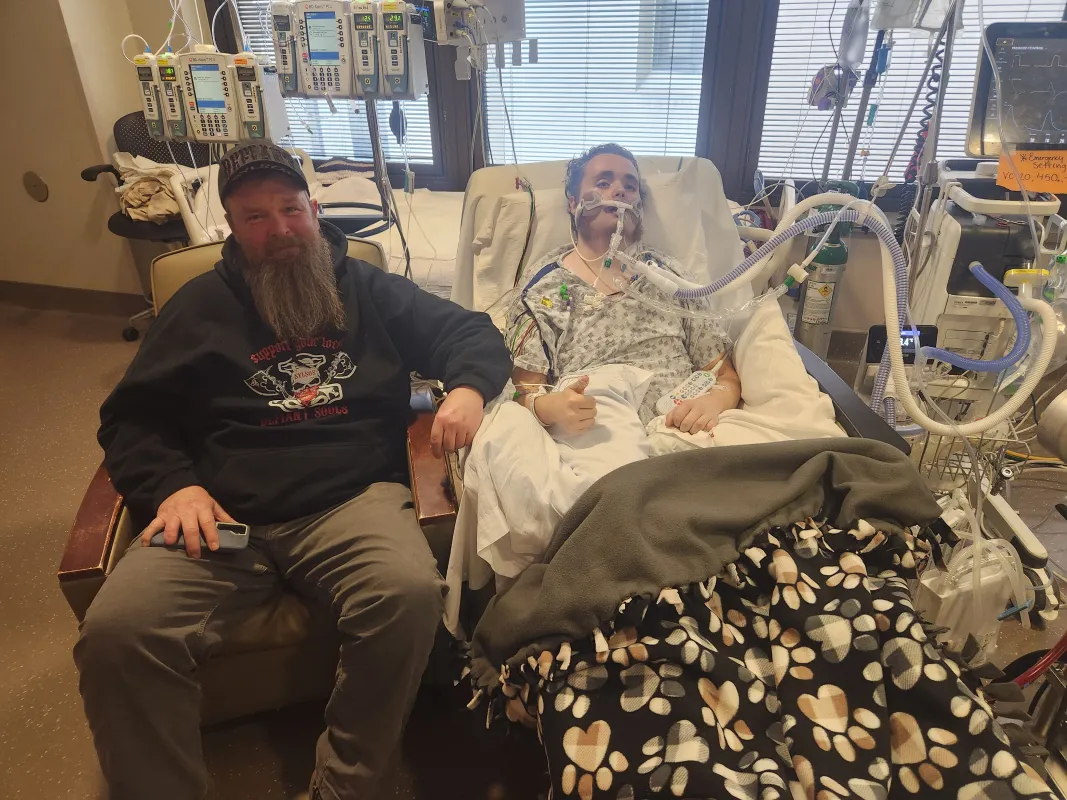
“I never really understood what the ICUs did or what it all entailed,” she says. “When that happened and he was in the ICU, it was a sharp learning curve for me.”
As Tevin remained critically ill, his family leaned on the people caring for him — not only for medical expertise, but also for reassurance and human connection.
Carol remembers a night when Dustin was struggling with the uncertainty of Tevin’s condition. A MICU nurse shared a video about another patient who had received ECMO care at UI Health Care and survived. “For Dustin, the story offered a small but meaningful glimpse of hope,” she recalls. “It really was just this little, tiny glimmer of light when there was none.”
A remarkable recovery
Eventually, Tevin began to turn a corner. As his condition improved, he started responding to people around him and communicating with gestures, including giving a thumbs-up.
Even while receiving intensive support, he began working with therapy and walking short distances in the hallway — progress that encouraged his family as they watched him regain strength.
Tevin eventually came off ECMO and mechanical ventilation. He received a tracheostomy to support his breathing during recovery and was discharged home. With follow-up care and time to heal, Tevin gradually regained his strength and returned to work as a welder in June.
A follow-up CT scan later showed that the changes in his lungs had resolved, with only a very small area of scarring remaining. Today, Tevin is back to doing the things he enjoys. For his family, it is a welcome change after months of uncertainty.
The people behind the care
For Carol, Tevin’s experience reinforced something she has believed throughout her career: “The people who care for patients are the ones who make the difference,” she says.
In her nursing role at UI Health Care Medical Center University, she sees the work of health care from a leadership perspective. But being on the family side of care gave her a deeper appreciation for the time, patience, and connection that patients and loved ones need.
She hopes Tevin’s story can remind other patients and their loved ones that they are not alone during an overwhelming time.
“When we look at Tevin now, we don’t just see the young man who survived a terrible illness,” she says. “We see every person who stood beside him — the nurses, respiratory therapists, ECMO team, doctors, therapists, chaplain, leaders, and everyone whose name we may not remember but whose hands touched Tevin’s care. You are all part of this story.”
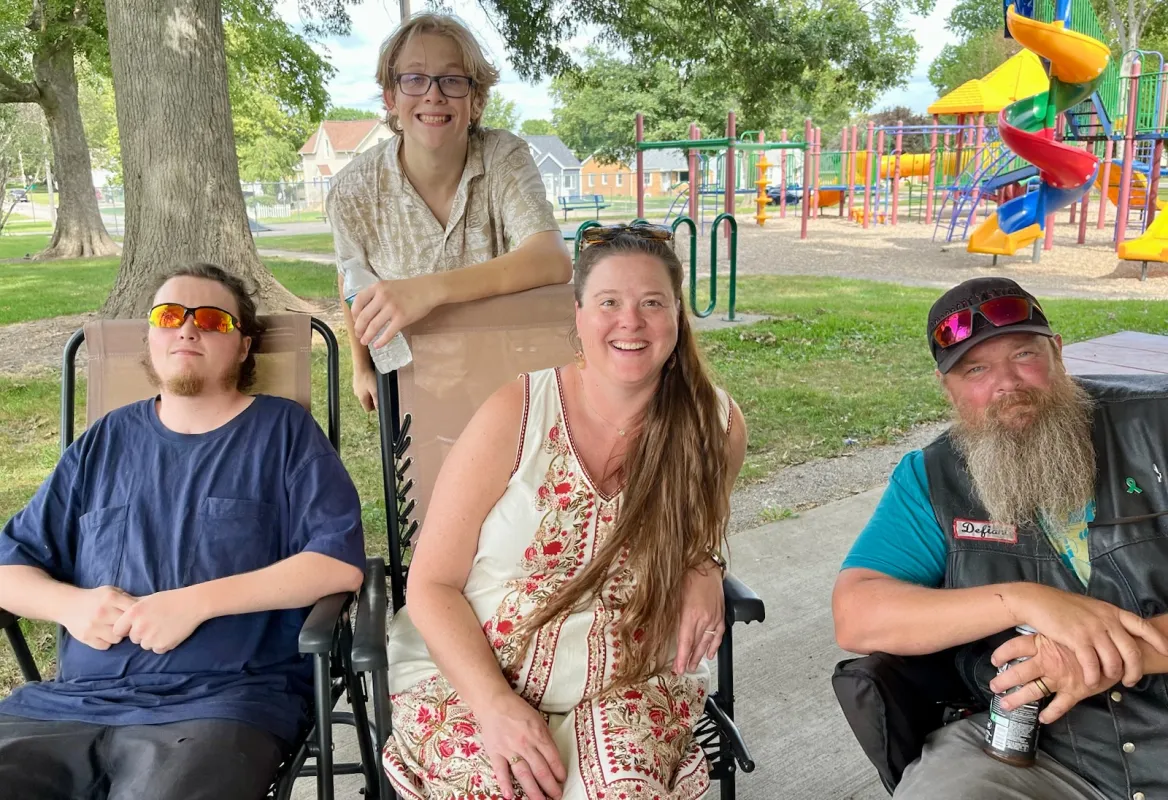
Read Carol's original letter of thanks
This story began with a heartfelt, in-depth letter Carol wrote to recognize and thank Tevin’s care team. Read her original message to see her full reflection on all the individuals and teams who made a difference for her family.
My name is Carol Haugen, and I am Tevin’s stepmom.
Today, I have the privilege — and honestly, the very difficult task — of telling you a story.
It is a story about fear.
It is a story about uncertainty.
It is a story about a family who suddenly found themselves in a place we never imagined we would be.
But most importantly, it is a story about Tevin.
Tevin Haugen is 25 years old.
He is a son.
He is a stepson.
He is a welder.
He is a grandson.
He is a stepbrother.
He loves comic books. He loves The Lord of the Rings. He loves our two dogs, Buddy and Beau. He loves going to the movies — and especially the popcorn.
He is funny. He is stubborn. He is independent.
He is Tevin.
And then, suddenly, Tevin became incredibly sick.
What started as a respiratory illness progressed to the point that he needed to be intubated.
Then a ventilator.
Then ECMO.
Then a tracheostomy.
Our 25-year-old son was fighting for his life.
And we were terrified.
Tevin spent almost a month at University of Iowa Health Care, most of that time in the MICU, then a short time on the Respiratory Specialty and Comprehensive Care Unit.
For our family, time stopped.
Days and nights blurred together.
There were monitors and alarms and machines everywhere.
There were words we had never wanted to learn.
Ventilator.
ECMO.
Trach.
Numbers we didn't understand.
Procedures we couldn't imagine.
And questions for which nobody had answers.
There were days when it seemed like every time we walked into the hospital, Tevin was worse than the day before.
And we would think:
How can this possibly be happening?
This was supposed to be our 25-year-old son.
He was supposed to be working.
He was supposed to be hanging out with his dogs.
He was supposed to be going to the movies.
He was supposed to be living his life.
Instead, he was fighting to stay alive.
And it felt unreal.
It felt like a nightmare that we couldn't wake up from.
His dad, Dustin, stayed with him every single night throughout his ICU stay.
Every night.
He slept at the hospital.
He watched.
He waited.
He listened.
He sat beside his son through the darkest hours.
And I became the person going back and forth between home and the hospital — taking care of the house, taking care of Buddy and Beau, bringing food and clothing, making sure Dustin had what he needed, and trying to keep some small piece of normal life going.
But there was nothing normal about any of it.
We were exhausted.
We were scared.
And we were desperately looking for something to hold onto.
Then there were all of you.
One of the things I will never forget about Tevin's care is that you never treated him like a diagnosis.
You never treated him like a body in a bed.
You treated him like Tevin.
You asked about him.
You talked to him.
You learned who he was.
You protected his dignity.
You never talked down to him.
And you never talked down to us.
You included us in the daily huddles.
You answered our millions of questions.
And I am certain there were days when you had already answered the same question three times and still answered it a fourth time because you knew we needed to hear it again.
You gave us honest information — even when it was hard.
You didn't give us empty promises.
You didn't tell us everything was going to be okay when you couldn't know that.
Instead, you told us what you knew.
You told us what you didn't know.
You told us what you were watching.
And then you went back to work trying to find the answers.
The doctors tested for everything they could think of.
And when one possibility was ruled out, they kept looking.
They didn't stop.
They didn't give up.
They kept asking:
What are we missing?
That determination meant everything to us.
And then there were the little things.
The things that might not appear in a medical record.
A joke at just the right moment.
A smile.
Someone asking Dustin how he was doing.
Someone checking on me.
Someone taking an extra moment to explain something.
Someone making us laugh when we weren't sure we could anymore.
Those moments mattered.
Because when you are living hour after hour in an ICU, you need more than medicine.
You need humanity.
And you gave us both.
To the nurses:
Kelley.
Liz.
Hailey.
Gretchen.
Kaitlyn.
Haylee.
Bridget.
Lisa.
Allison.
Taylor.
Jacey.
Abby.
Jenna.
Aurora.
Maddie.
Allison.
Zayla.
Erin.
Some of your names are forever connected to the hardest days of our lives.
But they are also connected to some of the most meaningful.
You cared for Tevin when he couldn't care for himself.
You watched over him when we couldn't.
You learned his quirks.
You protected him.
You advocated for him.
You cared for the person underneath all those tubes, lines, machines, and numbers.
And some of you became familiar faces that gave us comfort simply because you were there.
Thank you will never feel like enough.
And Jenna, there is one moment with you that I don't think we will ever forget.
It was nighttime.
Dustin had been there night after night, sitting beside his son, watching the machines, listening to the alarms, and trying to make sense of a situation that seemed impossible.
There was so much darkness.
So much fear.
So much uncertainty.
And during one of those nights, Jenna showed Dustin a video of a previous patient who had been on ECMO – and had survived.
It may have seemed like a small things.
It wasn’t.
For Dustin, sitting there beside Tevin in the middle of the night, it was a glimmer of light in absolute darkness.
It gave him something we desperately needed in those moments:
Possibility.
It didn’t promise us that Tevin would have the same outcome.
It didn’t erase the fear.
It didn’t change what was happening in the room.
But for a few minutes, it allowed Dustin to see beyond the machines.
Beyond the ECMO circuit.
Beyond the terrifying reality of that night.
It allowed him to imagine that maybe–just maybe–there could be another ending.
And today, knowing that Tevin is home, healthy, whole, and back at work, that moment means even more.
Jenna, you didn’t just show Dustin a video.
You gave him a reason to look past the darkness.
You gave him a tiny glimpse of a future we couldn’t yet see.
And somehow, that future became ours.
Thank you for that glimmer of light.
To the respiratory therapists:
Jess and Alyssa.
Thank you for the expertise and the patience you brought to Tevin's care.
Thank you for helping us understand the machines that had suddenly become part of our lives.
To physical therapy:
Austin.
Thank you for seeing possibility when all we could see were limitations.
Thank you for remembering that there was a young man underneath everything who needed to find his way back to his life.
To the ECMO team:
Sam.
Courtney.
Seth.
Tina, lead.
Kylie.
We never imagined ECMO would become part of our family's vocabulary.
We never imagined we would stand beside a machine that was helping keep our son alive.
But you knew exactly what you were doing.
You watched.
You adjusted.
You responded.
You fought alongside him.
And you gave our family something priceless:
Time.
Time for Tevin to fight.
Time for his body to heal.
Time for us to hope.
To the doctors:
Dr. Josalyn Cho.
Dr. Pysick.
Matt.
Dr. Bre Fornalski.
Dr. Desmond Barber.
Thank you for carrying the enormous responsibility of caring for a 25-year-old man with a frightening illness and very few easy answers.
Thank you for continuing to search.
Thank you for explaining.
Thank you for listening.
Thank you for being honest.
And thank you for never losing sight of the person you were treating.
Dr. Fornalski, I especially remember that you were pregnant during all of this. And yet you continued showing up and caring for Tevin and for our family with such dedication.
Those details stay with families.
You may not remember every conversation.
We do.
Dr. Josalyn Cho
And Dr. Cho, there are not enough words to express what your presence meant to our family.
You had a calm, serious demeanor that seemed to bring a sense of steadiness into a situation that was anything but steady.
You had a gently manner with Tevin.
Event when the circumstances were frightening, you spoke to him with respect and kindness. You never lost sight of the person lying that bed.
But underneath that calm was an incredible resolve.
You were determined to find answers.
When we didn’t have answers, you kept looking.
When things became more complicated, you kept going.
When the situation seemed to change by the hour, you remained focused.
You led the medical team — and you led us — through what felt like unrelenting turmoil.
You helped us navigate conversations we never imagined we would have to have.
You helped us understand what was happening when everything felt overwhelming.
You gave us honesty when honesty was hard.
And somehow, through all of it, you gave us the sense that Tevin was being watched over by someone who was not going to stop fighting for him.
Your calm didn’t mean you didn’t understand the seriousness of what was happening.
We knew you did.
Your calm gave us something to hold onto while everything around us felt like it was falling apart.
And your resolve gave us hope.
Dr. Cho, you were not simply Tevin’s doctor during the most frightening time of his life.
You were the person at the helm helping guide us through the storm.
We today, when we see Tevin healthy, whole, and back to the life he loves, we know that your determination to keep searching for answers was part of the reason we get to see that day.
Thank you for leading Tevin and all of us through the darkness.
Dr. Bre Fornalski
And Dr. Fornalsjy, we will always remember the way you cared for both Tevin and Dustin during one of the most frightening decisions we faced.
Your patient, calm manner gave us a sense of peace when there wasn’t much peace to be found.
I especially remember the conversation with Dustin about the lung biopsy.
You took the time to talk him through it — to explain what you were looking for, what the procedure involved, and the risks and benefits. You didn’t minimize the risks or try to make a frightening decision sound easy.
You gave it to him straight.
But you did it with so much compassion and kindness.
You understood that Dustin wasn’t just a father listening to a medical explanation.
He was a father being asked to make decisions about his son’s care while his son was critically ill.
You gave him the information he needed to make that decision, but you also gave him something just as important:
Peace.
You listened.
You answered his questions.
You never rushed him.
And you spoke with a kindness that made an incredibly difficult conversation a little easier to bear.
We will always be grateful for the way you cared for Tevin, but also for the way you cared for his dad.
Those moments may have been part of your job, but to our family, they were so much more than that.
They were moments when someone helped carry a little bit of the weight for us.
And we will never forget it.
Thank you for your patience, your honesty, your compassion, and your kindness.
To Supportive Care:
Danilo and Chaplain Laurel.
Thank you for recognizing that the people surrounding the bed were hurting too.
Thank you for caring about our hearts and our spirits when medicine couldn't fix what we were feeling.
Thank you for helping us carry something that was sometimes simply too heavy.
And to the leaders who supported this incredible team:
Nathalee.
Sarah.
Jess.
Lilly.
Megan.
Britt.
Cody.
Tom.
Karen.
Thank you for supporting the people who were caring for our son.
Because we know that exceptional care doesn't happen by accident.
It happens because people choose to care.
Nathalee and Lilly
And Nathalee and Lilly, there is another moment that stayed with us.
Tevin was terrified.
He had already been through so much... so many procedures, so much pain, so much uncertainty. And now he needed a feeding tube placed.
We knew it was necessary.
But knowing something is necessary doesn’t make it any easier to watch your child go through it.
Your expertise made the procedure possible, but it was what you did beyond the medical skill that we will remember most.
You held Tevin’s hand.
You stayed with him through his fear and his pain.
You gave him reassurance when he needed it most.
And there came a point when Dustin and I simply couldn’t stand watching our son go through one more painful procedure.
We had reaching our limit.
We couldn’t watch.
But you could.
You stayed.
You held his hand when we couldn’t.
You became the comfort that we weren’t able to provide in that moment.
That is something we will never forget.
Because caring for someone isn’t always about the procedure itself.
Sometimes it’s about recognizing the fear in someone’s eyes and making sure they don’t face it alone.
Nathalee and Lilly, thank you for your expertise.
Thank you for your steady hands.
But most of all, thank you for holding Tevin’s hand when his dad and I couldn’t bear to watch.
In those moments, you weren’t just doing your jobs.
You were taking care of our son.
And you were taking care of us, too.
Megan, Nathalee, Jess, and Britt
And Megan, Nathalee, Jess, and Britt, this one is especially personal for me.
You weren’t just part of Tevin’s care story.
You were my teammates.
While my family was living through this nightmare, you quietly filled in all the gaps I couldn’t fill myself.
You covered for me.
You picked up what I couldn’t get done.
You gave me permission to step away from everything that suddenly seemed so unimportant compared to what was happening at that hospital.
But more than that, you gave me a place to fall apart.
You let me vent.
You let me cry.
You let me be angry.
You let me rage against the unknown horror that was waiting for us every time we talked through those hospital doors.
You never judged me.
You never made me feel like I needed to pull myself together.
You were simply kind.
Gently.
Patient.
Comforting.
And when I was struggling with the guilt of not being at work, with all the things I thought I should be doing, you reminded me of something I needed desperately to hear.
You told me where I needed to be.
With my husband.
With my stepson.
You reminded me that a job is a job.
Work will be there.
The emails will wait.
The responsibilities will still be there tomorrow.
But family?
Family is what really matters.
Those words gave me permission to stop trying to be everything to everyone and simple be where I needed to be — with Dustin and with Tevin.
Megan, Nathalee, Jess, and Britt, you cared for me during a time when I was barely holding myself together.
You helped carry the pieces of my life that I couldn’t carry.
And I will never forget that.
Because while the ICU team was helping save Tevin, you were helping make it possible for me to be there beside him.
You reminded me that sometimes the most important thing we can do isn’t go to work, solve a problem, or keep everything running.
Sometimes the most important thing is simply to be there for the people we love.
Thank you for giving me that gift.
Thank you for filling in my gaps.
Thank you for letting me cry, vent, and rage.
Thank you for being kind when I couldn’t be strong.
And most of all, thank you for reminding me where I belonged.
With my family.
There is one more person we need to thank.
Dr. Gross in the Pulmonary Clinic.
Because the story didn't end when Tevin left the ICU.
Leaving the hospital was not the same thing as being recovered.
There was still healing to do.
There was still follow-up.
There were still questions.
And Dr. Gross provided expert follow-up care and continued to help guide Tevin on the road back to health.
For that, our family is deeply grateful.
And now I want to tell you something.
Something I wish we could have told you during those darkest days.
Something I hope you will carry with you the next time you walk into an ICU room and see a young person fighting for their life.
It worked.
He made it.
Tevin is here.
Tevin is whole.
Tevin is healthy.
And Tevin is living his life.
He is back to work.
He's a welder again.
He goes to the movies.
He eats the popcorn.
He reads comic books.
He talks about The Lord of the Rings.
He loves Buddy and Beau.
He is doing the ordinary things that, after what we went through, don't feel ordinary at all.
Going to work isn't ordinary to us anymore.
Watching a movie isn't ordinary.
Eating popcorn isn't ordinary.
Coming home to the dogs isn't ordinary.
Having our son healthy and home isn't ordinary.
It is a miracle we get to experience every day.
And when we look at Tevin now, we don't just see the young man who survived a terrible illness.
We see every person who stood beside him.
We see the nurses who turned him.
The respiratory therapists who watched his breathing.
The ECMO team who kept fighting.
The doctors who kept searching.
The therapists who helped him move forward.
The chaplain who helped us find words when we had none.
The leaders who supported the team.
And every person whose name we may not remember but whose hands touched Tevin's care.
You are all part of this story.
There is something families of critically ill patients understand that I don't think you can truly understand unless you've lived it.
We remember.
We remember everything.
We remember who was there.
We remember who looked us in the eye.
We remember who told us the truth.
We remember who made us laugh.
We remember who sat down.
We remember who said, "We're still looking."
We remember who treated our son with dignity when he couldn't speak for himself.
We remember.
And we will always remember you.
When Tevin was lying in that ICU bed, surrounded by machines, we couldn't see this ending.
We couldn't picture him back at work.
We couldn't picture him walking through our front door.
We couldn't picture him sitting on the couch with Buddy and Beau.
We couldn't picture movie theaters.
We couldn't picture popcorn.
We couldn't picture normal.
But you could.
Or at least, you never stopped working toward the possibility of it.
You kept fighting for the future we couldn't see.
And now we get to live in that future.
So, from Dustin and me, from our entire family, and most importantly, from Tevin:
Thank you.
Thank you for your knowledge.
Thank you for your skill.
Thank you for your patience.
Thank you for your honesty.
Thank you for your compassion.
Thank you for your humor.
Thank you for the big things.
And thank you for the little things.
Thank you for caring for Tevin's body.
But even more than that — thank you for caring for Tevin.
Thank you for seeing the person behind the diagnosis.
Thank you for protecting his dignity.
Thank you for treating him like the 25-year-old man he is.
Thank you for giving him the chance to come home.
And thank you for giving us back the life we were afraid we had lost.
Because today, when I look at Tevin, I don't see the ventilator.
I don't see the ECMO machine.
I don't see the trach.
I don't see the monitors.
I see my stepson.
I see a welder.
I see a comic book in his hands.
I see him talking about The Lord of the Rings.
I see him at the movies, waiting for the popcorn.
I see him with Buddy and Beau.
I see him living.
And I see something else.
I see every one of you who helped make that possible.
You became part of our family story during one of the darkest chapters of our lives.
And because of what you did, that chapter has a different ending than we ever dared to hope for.
Tevin is home.
Tevin is healthy.
Tevin is whole.
And Tevin is living.
For a family who once wasn't sure if we would ever see that day — there are no words big enough for our gratitude.
So we will simply say the words that we mean with every part of our hearts:
Thank you for saving our son.
Thank you for caring for our family.
And thank you for giving us Tevin back.
We will never forget you.
The Haugens
Patient Stories