Wife donates kidney to husband with UI Health Care’s first robotic living donor nephrectomy
Lynette Marshall and Jeffery Ford demonstrate generosity, love, and gratitude after transplant surgery at UI Health Care
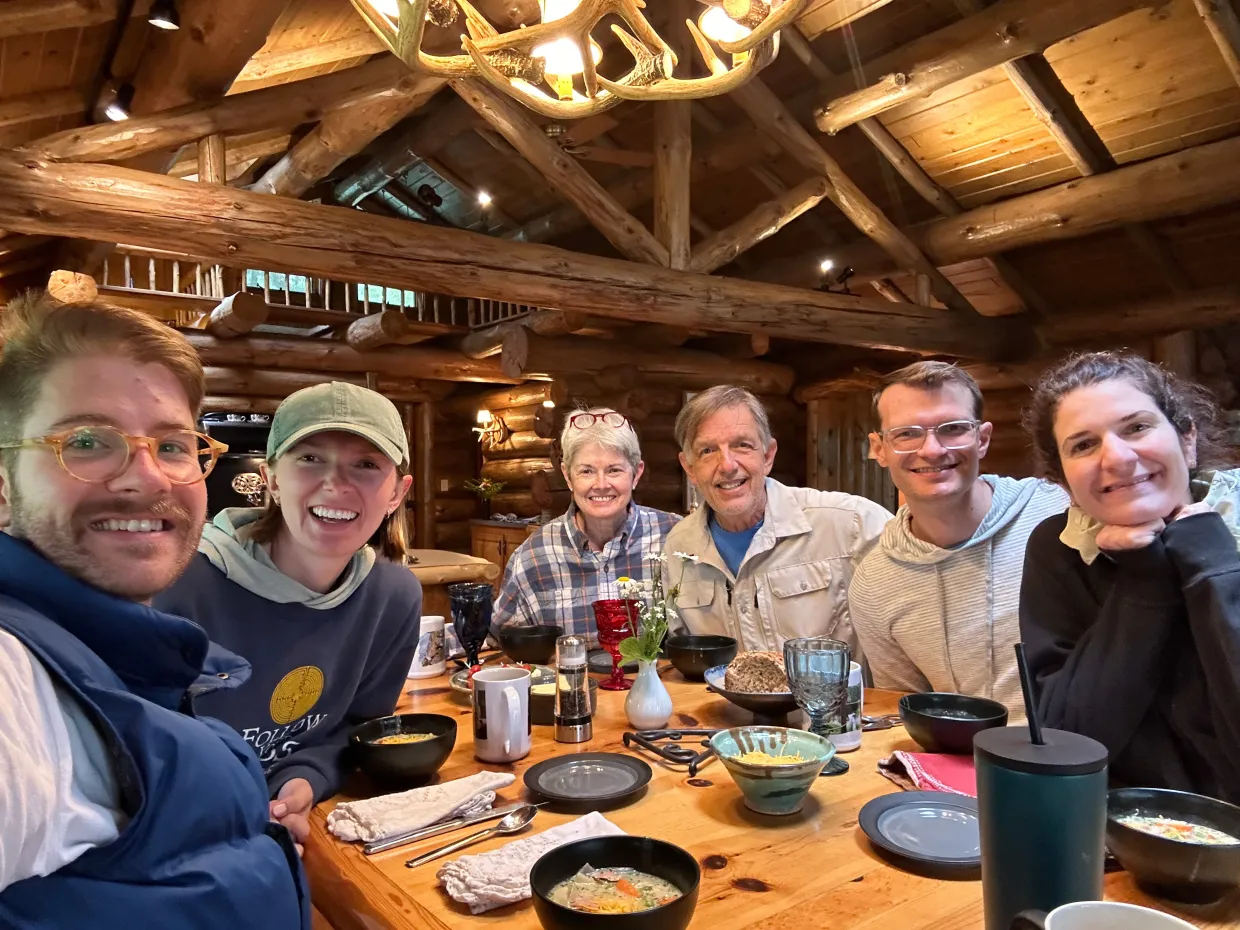
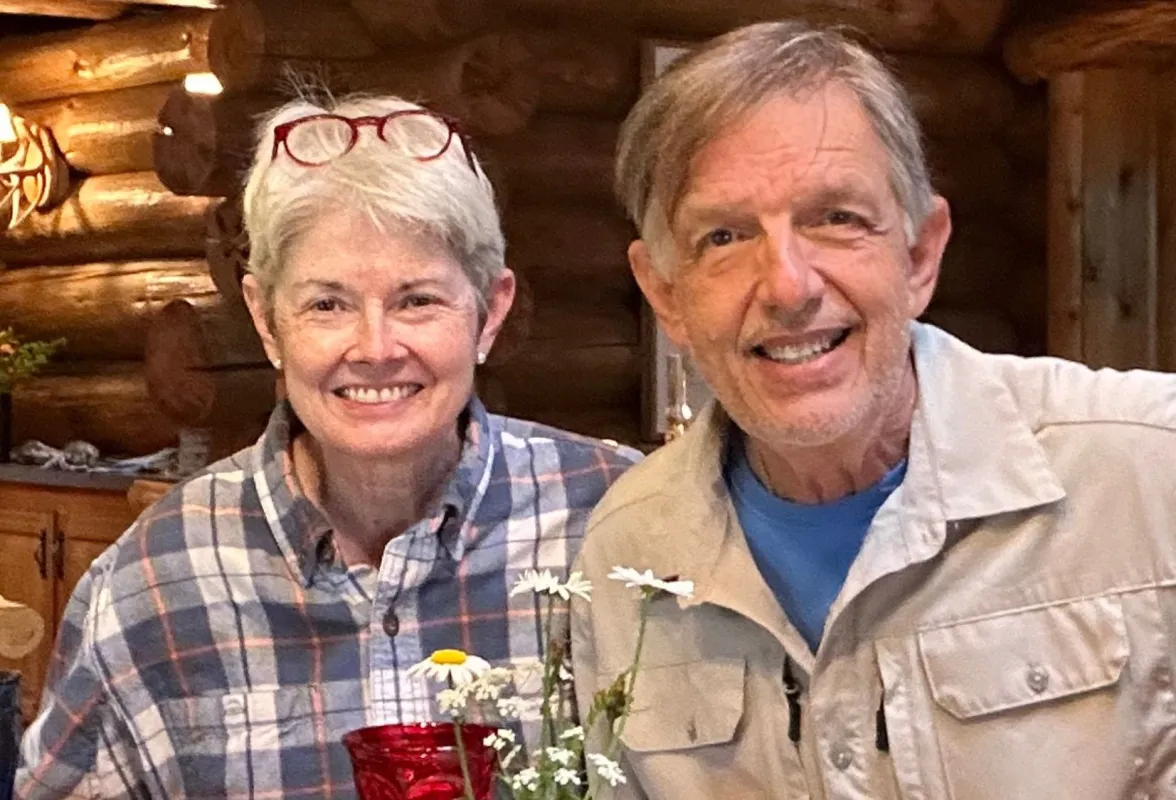
Some people give and some people take. But Lynette Marshall and Jeffery Ford share. From their compassion for community to a seemingly innate sense of philanthropy, the couple’s marriage is defined by love and generosity.
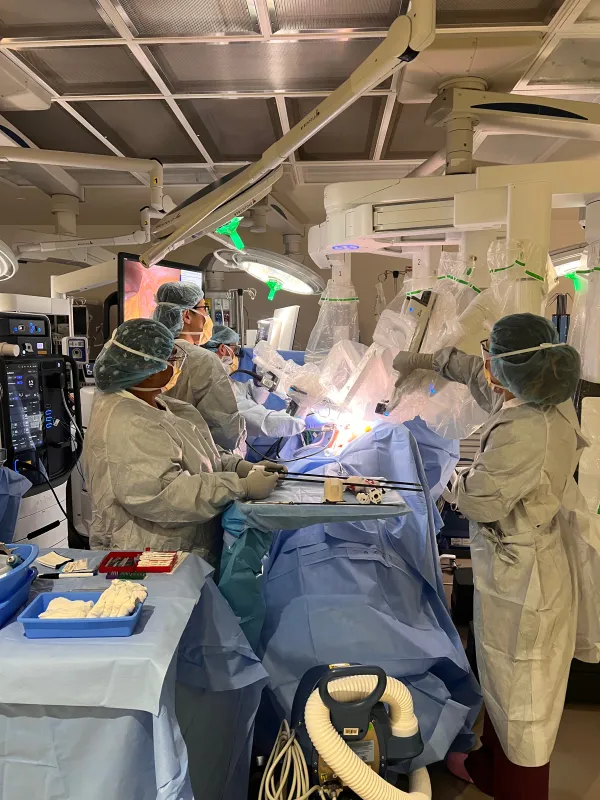
In December, Ford received one of the greatest gifts a partner can provide. When his kidney failure called for a transplant, Marshall stepped in as his donor. Her donation would be University of Iowa Health Care’s first robotic living donor nephrectomy.
“She’s a very generous person, and it is just another example of her generosity, and part of the reason I love her,” Ford says, noting that both his wife and brother, Jerry Ford, also offered to donate a kidney. He sees it as a level of kindness that is of the highest magnitude.
“It’s kind of overwhelming at the same time because it’s not something you take lightly asking a person to consider,” he says. “And when they say yes, it’s an amazing experience.”
Ford’s medical journey is equal parts incredible and harrowing after a severe illness racked his body roughly 12 years ago, eventually leading to the need for a kidney transplant. The couple attributes their resilience and perseverance to their family and the compassionate experts at UI Health Care.
A years-long journey to transplant
The two have been coming to UI Health Care for their medical needs for nearly two decades. It’s a place they trust and where people know them. But that sense of familiarity comes out of years of medical adversity.
Ford’s first major health event was in 2011 with trigeminal nerve surgery, but it was a near fatal illness that changed his life less than two years later in 2013.
While visiting the couple’s son Michael in San Francisco, Ford experienced septic shock landing him in a California hospital for two weeks. The condition, in which blood pressure drastically drops and damages most vital organs, comes as a progression to sepsis, a potentially deadly infection. Once he was stable enough in California, Ford was transported back to Iowa and under the supervision of experts with UI Health Care.
“I was barely conscious. I wasn’t intubated anymore, but I was still on dialysis,” he says.
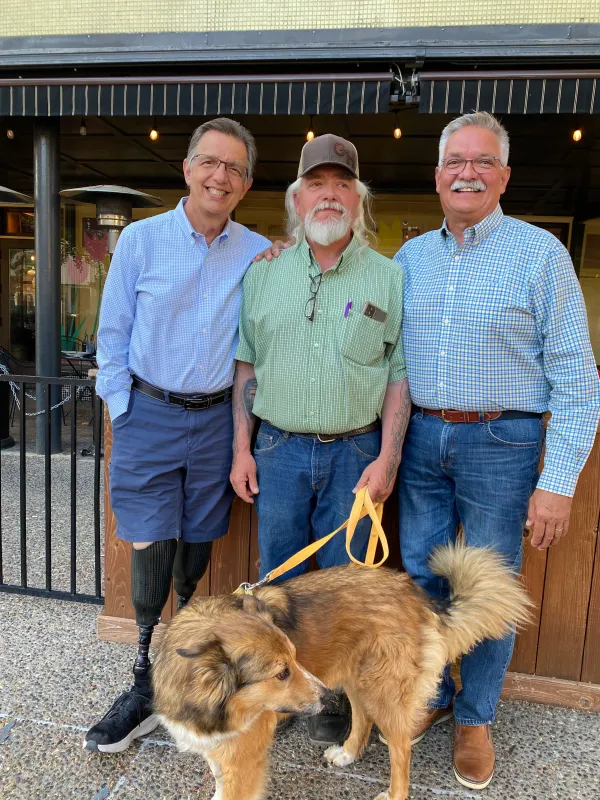
Within 12 hours of returning to Iowa, doctors and surgeons informed the couple that the septic shock had caused enough damage that Ford’s legs and fingers would need to be amputated. He ended up spending two and a half months at UI Health Care university campus.
While some of his care team have since retired, the couple is grateful for the compassion and sense of connection they felt from so many faculty and staff.
“We are very much community people, and I just can’t imagine health care without that quality, and, fortunately, it’s here in droves,” Ford says.
Initially, doctors thought a kidney transplant would be in Ford’s near future, but, thankfully, his body was able to bounce back enough that the need for transplant was put off until 2025.z
The psychology of rehab
While his kidneys recovered with careful attention to diet and medication, Ford was faced with a rehab journey and intense physical therapy so that he could learn to walk again with the use of prosthetics.
Ford says his physical therapist, now-retired Dick Evans, encouraged him to appreciate the little steps he achieved and not to focus on what he wasn’t able to do yet.
“The rehab people are as much about the psychology of healing as they are about the physical part of healing and I think they are unsung heroes in that regard,” he says.
His wife remembers a prime example of such a philosophy where the physical therapist helped simulate an activity Ford loved.
“We spent all of our family vacations doing wilderness canoeing and camping,” she says. “And I distinctly remember one of the things Dick helped Jeffery with was putting these little half-moon-shaped spheres on the floor that were stand-ins for rocks in the lake in the Boundary Waters that you would have to step on.”
The couple appreciates the UI Health Care team’s focus on helping them return to the things they loved and have since taken multiple outdoor vacations, including two weeks-long trips down the Colorado River and through the Grand Canyon.
A health system first
Since the septic shock, Ford has had regular appointments to monitor his kidneys.
“Things got better after the septic shock, but then about a year and half ago we started noticing a decline,” he says. “Last summer it became apparent that we needed to follow up on the transplant conversation.”
“I had tested back in 2013 and knew at that time that I was a match,” Marshall says, adding that a previous result wasn’t a guarantee that she would be a match in 2025. “We hoped I would still be able to do that, and fortunately I was.”
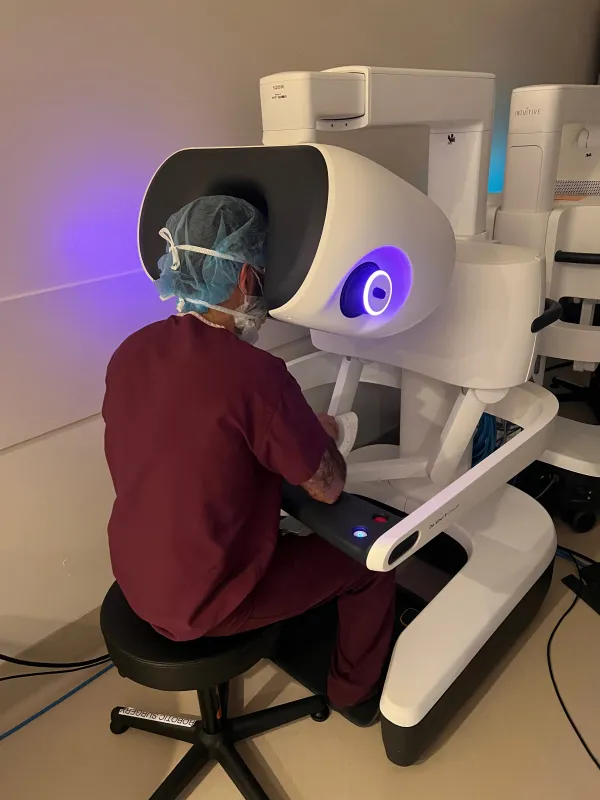
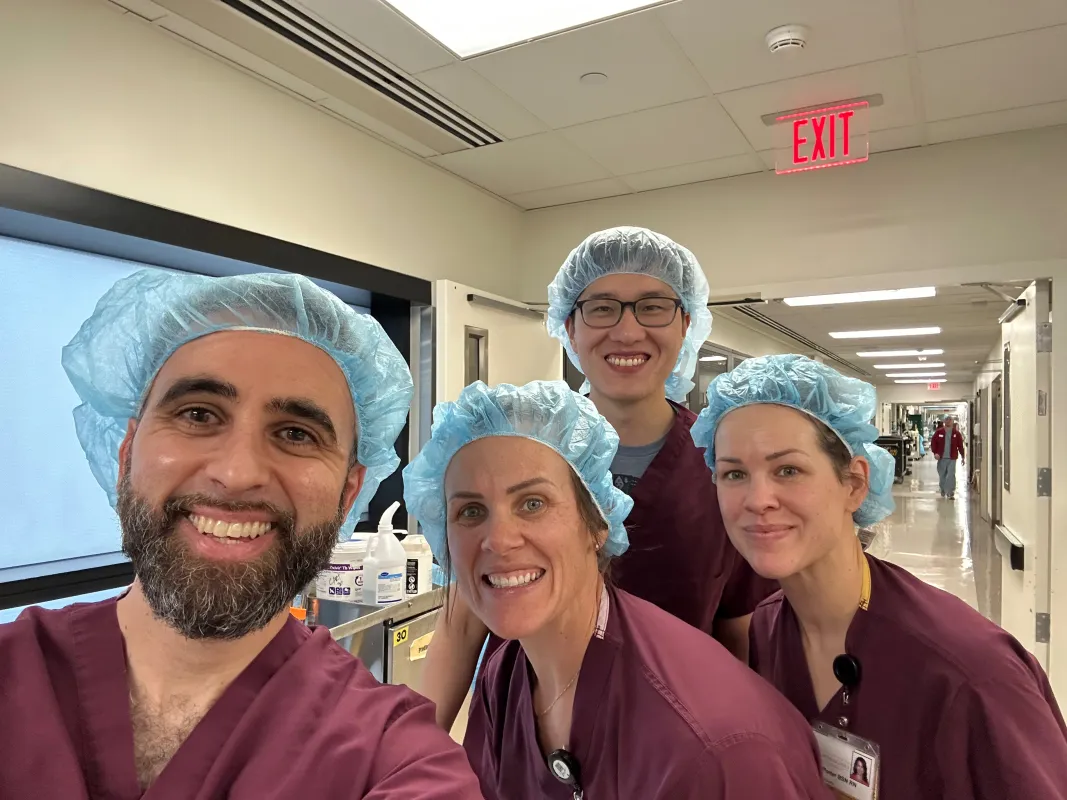
While undergoing a day-long series of tests, she met Ramy El-Diwany, MD, PhD, who had recently arrived at UI Health Care from Johns Hopkins Medicine where he trained on robotic nephrectomy, the procedure in which a kidney is surgically removed. The chief of transplant surgery, Alan Reed, MD, MBA, FACS, asked if Marshall would be open to being the first robotic nephrectomy with UI Health Care. Her answer was simple and direct.
“I said, ‘Sure, why not?’” she says. “Look, I trust UI Health Care."
Ford was comfortable with his wife’s decision as he had his own experience with robotic surgery years prior for prostate cancer. Robotic surgery is often minimally invasive and simultaneously decreases the risk of infection and a patient’s recovery time.
‘Your best bet’
Surgery for both Ford and Marshall occurred mid-December, and recovery began immediately after. With the help of their children, family, as well as many friends the couple are on the up and up.
“I honestly haven’t taken more than a regular Tylenol three or four times,” Marshall says. “I was back to work in less than four weeks.”
Because of his other health challenges, Ford’s recovery has been more challenging. In early February, he says he was slowly increasing his activity, including walking and chores around the house.
“I’m getting there,” he says. “I can imagine that three months after transplant, when we start drawing down some of the medications, I’ll only be limited by how strong I am or how much endurance I have at that point.”
The couple remains incredibly grateful for one another, their family and friends as well as the care provided by those at the hospital. When asked what he would tell others about UI Health Care, Ford was nothing but encouraging.
“I tell friends and family from rural areas that, ‘Yes, UI Health Care is big. But it’s filled with great people and it’s your best bet,” he says. “I can’t recommend it enough.”
Patient Stories