3,500
high school athletes cared for in 2025
A serious spinal cord injury changed Layne Hearne’s life in an instant, but immediate and specialized care from the sidelines to the operating room helped him keep moving forward.
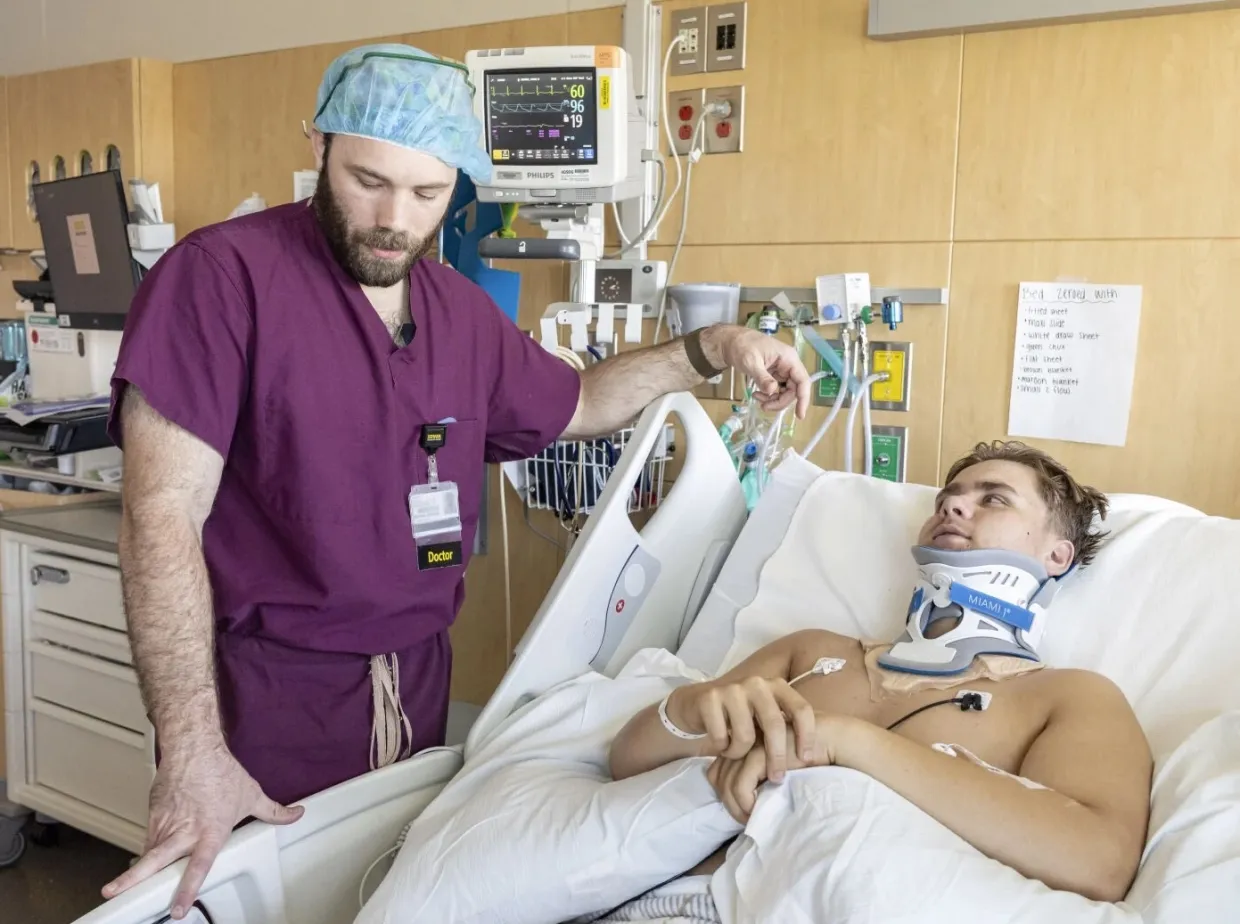
May 3, 2026, started as a normal day for Layne Hearne, a high school wrestler from Ankeny. But in a split second, his life changed forever. Hearne was wrestling in Cedar Rapids when he was thrown headfirst to the mat by his opponent, hit the top of his forehead, and broke his neck.
“I tried to get up. I couldn't get up,” says Hearne, who was two weeks shy of his 16th birthday. “I knew something wasn't right."
It would quickly become clear to the crowd — and his parents — that something was very wrong.
"He looked lifeless on the mat," his mother, Jessica Simmons, recalls. “In other times when he's been dropped and injured, he's still somewhat moving, but this time, he wasn't moving at all.”
Hearne was unable to move his arms or legs and only had limited sensation in his neck and torso — which he later found out was because he had fractured his C6 vertebrae and dislocated his C7 vertebrae.
A University of Iowa Health Care orthopedic resident physician, Brandon Marshall, MD, was providing medical coverage at the event through the University of Iowa Sports Medicine Outreach program.
As a wrestler himself — he wrestled in the 2024 Greco-Roman Olympic Trials — Marshall quickly jumped in to assist Hearne. He may just have been the perfect person to be on the sidelines that day.
"I was able to help put the pieces together not only on the clinical side, but on the wrestling side, too,” Marshall says. “Having seen similar injuries in the hospital before, I could quickly decide what to do. Everyone knew something was wrong, but they didn't know how to proceed, and that was the part where I was really able to help."
Marshall performed an initial exam and stabilized Hearne’s spine while informing his parents, Jessica Simmons and Laine Weston, and his coach, TJ Moen, about the injury and what the immediate next steps would be.
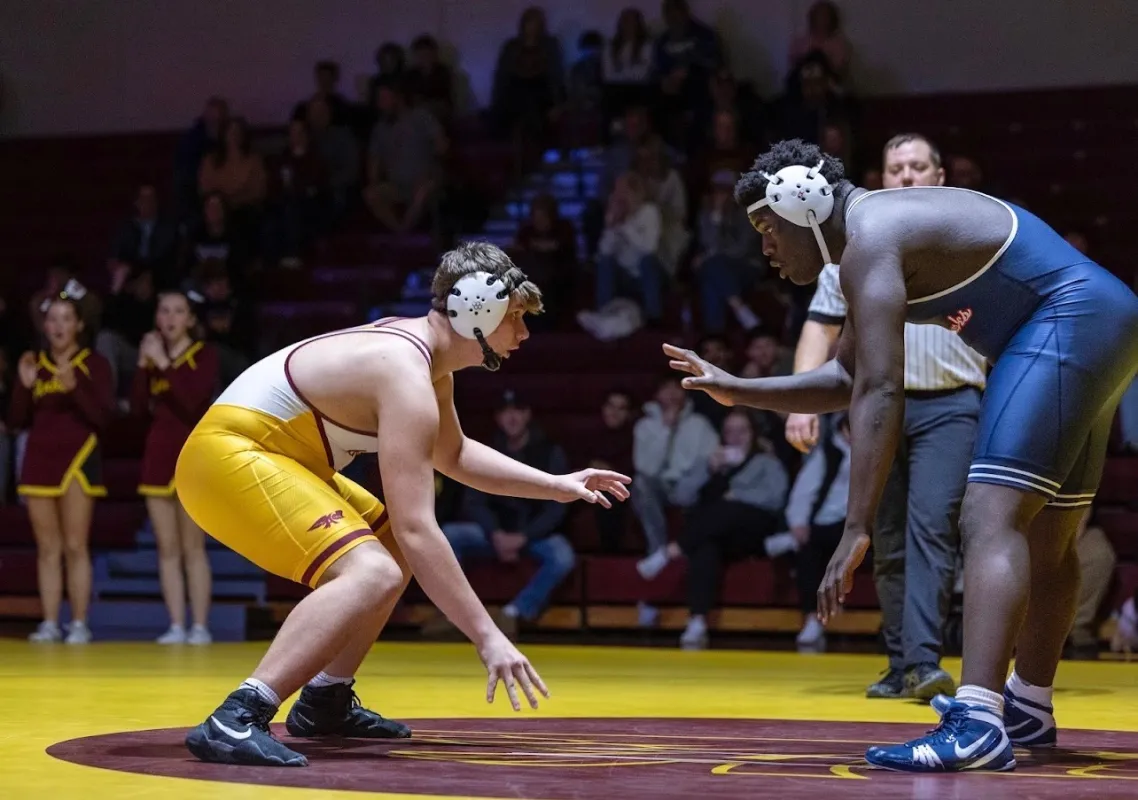
The time between the 911 call and the ambulance arrival was chaotic — Hearne's parents made calls to his grandparents and siblings, tracked down his wrestling bag, and supported their son through the most challenging moments of his life.
"Layne kept asking — 'Where's my mom?' so I went over to him and he said to me, 'You can cry, mom,'" Simmons says. "I said, 'No buddy. I'm going to be strong for you right now.'"
When the ambulance arrived, Marshall knew that after evaluation, any emergency room in Cedar Rapids would likely transfer Hearne to UI Health Care’s university campus for their orthopedic and spinal expertise. He advised the EMTs to take Hearne straight to university campus — a diversion from the typical protocol of going first to the nearest hospital. But for a spinal cord injury, timing is of the essence — the longer the wait for treatment, the more damage there could be.
“I knew it would save everybody a couple extra hours if he just went directly to his definitive care spot," Marshall says.
Marshall’s ability to expedite Hearne’s care to UI Health Care is just one example of the benefits of the University of Iowa Sports Medicine Outreach program. Through the program, nine area high schools, various youth sports organizations, and local sporting events partner with UI Health Care to receive athletic training services, emergency care, and physician coverage. In 2025, the program provided care for approximately 3,500 high school athletes.
While most high school athletes and their parents may not even notice their presence when things are going well, physicians, physical therapists and athletic trainers on the sidelines can make all the difference when disaster strikes.
"When someone is injured, our sports medicine outreach program ensures someone can immediately evaluate and intervene should it be a critical need, such as a spine injury," says Matthew Doyle, MS, LAT, ATC, director of the outreach program. "Our athletic trainers and physicians are there to help the patient navigate through the health system afterwards to receive the care they need.”
On-call orthopedic surgeon and spine specialist Catherine Olinger, MD, MS, FAAOS, FAOA, was waiting for Hearne when he arrived at UI Health Care’s university campus emergency department. The initial X-rays showed what they all feared: unfortunately, the damage to his spinal cord was likely permanent.
"He's a heavyweight wrestler and was dropped on his head,” Olinger says. “It's a lot of high energy which leads to a lot of spinal disruption. When somebody dislocates their neck like that, it is very difficult to get their vertebrae back in the right place."
Olinger and her team started the surgery by trying to manually align Hearne's neck while he was still awake, hanging him in traction to decompress his spine. Traction was unsuccessful in reducing the pressure on his spinal cord, so Olinger performed a cervical thoracic fusion of his C5-T2 vertebrae.
While the surgery provided the best possible outcome for Hearne, when Olinger explained the care plan to Hearne and his parents, she also had to share the devastating news that it is unlikely he will ever wrestle again.
“That broke me,” Simmons says. “I could tell that Dr. Olinger was struggling to give him that news. She truly showed him nothing but compassion throughout his whole time with her.”
The emotional toll on the family was unimaginable.
"Layne has been wrestling since he was 3 years old,” Simmons says. “Football and wrestling are a huge part of his life. It was overwhelming to think that now his whole life will be drastically different than we ever could have imagined."
Despite the challenging long-term outlook, there were small bright spots.
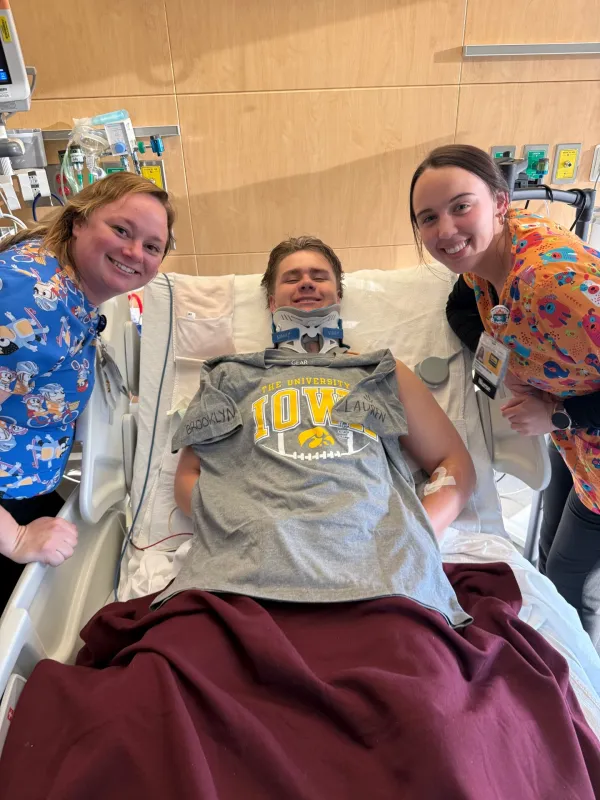
Hearne started to see progressive improvement in moving his upper extremities and was discharged to the pediatric ICU (PICU) at Stead Family Children's Hospital for neurologic monitoring, where he stayed for 11 days. Although the surgery was over, the challenges ahead were immense: he was unable to roll in bed, move his trunk and legs, or perform everyday skills independently.
In those 11 days, Hearne received countless visitors: Ankeny High School wrestling and football teammates, family members, and friends all stopped by to show their support. Word of his injury spread, and several wrestling and football stars showed their support, including Bobby Telford, Dan Gable, Dan McCarney; the United States Greco-Roman team; and the current Iowa wrestling team and Iowa State coach Kevin Dresser, to name a few.
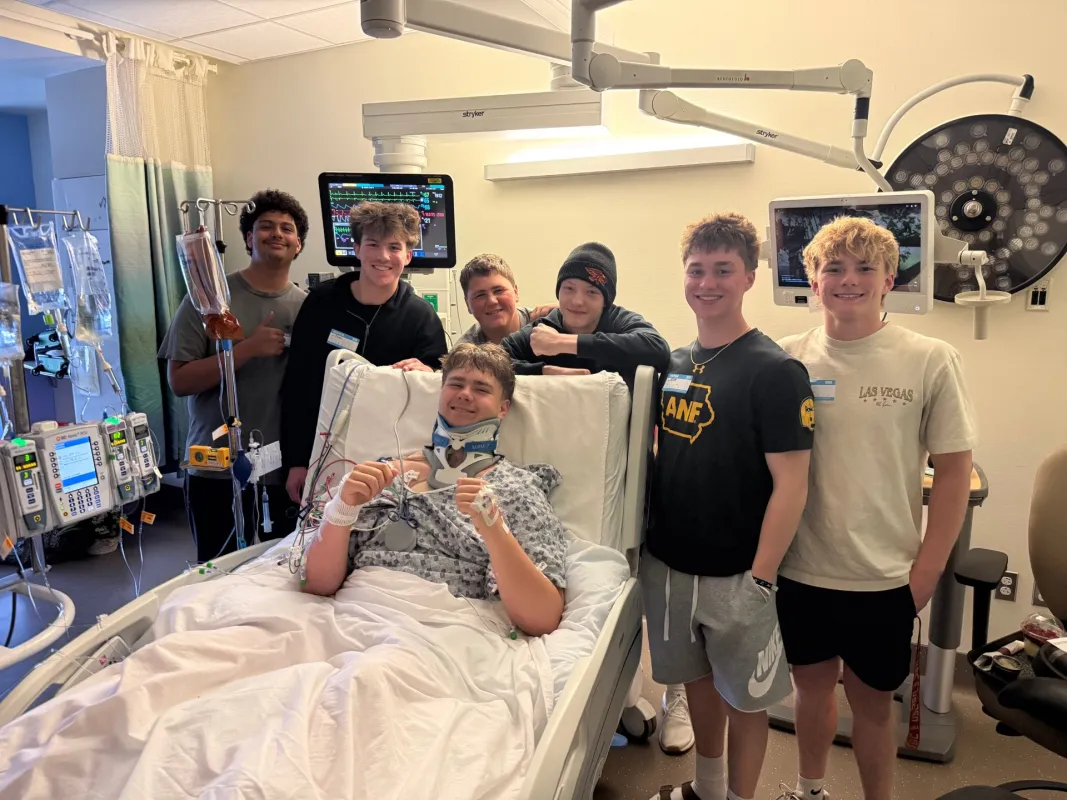
"It's been really neat to see all the people rallying behind and supporting me,” Hearne says. “They're people I look up to and are pretty big people in the sports world."
His stepmom, Laine Weston, agrees.
"I think the community started the fire in Layne to keep fighting. He was convinced that after a couple of weeks, this was all going to die off and be 'old news',” Weston says. “But that wasn't the case. He started to see that people are going to keep supporting him all the way through this."
Hearne was discharged to Madonna Rehabilitation Center in Omaha, Neb. in mid-May, where he worked on relearning everyday tasks and movement of his upper body and arms. In July, he moved to a room at On With Life, a neurological rehabilitation center in Ankeny, allowing him to be closer to home.
He continues to enjoy frequent visitors and has made leaps and bounds in his rehabilitation — he can now brush his teeth, transfer himself in and out of his wheelchair, dress himself, and use his cellphone independently. He is working on supported standing and building diaphragm strength. He is also attending football practices and half-days of classes at Ankeny High School, which has brought back a sense of normalcy.
Although the future is uncertain, there is still hope that Hearne may walk — but his top goal is getting the dexterity back in his hands, which will help him regain more independence. Regardless of what's next, his youth and past athletic ability are likely to contribute to a strong recovery.
Reflecting on the life-changing journey this has been, Simmons is incredibly grateful for the medical care Hearne has received at UI Health Care, from the sidelines to the operating room.
"Having Dr. Marshall there on the sidelines to jump into action immediately made all the difference that day,” Simmons says. “The whole team at UI Health Care had the utmost care for Layne. They got to know him and his personality outside of his injury. I think that's a huge part of what kept his spirits so high."
Hearne is determined to keep moving forward and meet new milestones every day. His parents and care team continue to be inspired by his outlook.
“With the attitude that he has, he's going to adapt well to whatever his situation ends up being,” says Marshall, who is now completing a fellowship in San Diego. “He's going to make the most of it.”
Simmons echoes that sentiment: "He’s looking at this new challenge and speed bump in life in the same way he would look at the weight room, the same way he would look at the wrestling mat, and the same way he would look at the football field: with grit and fight.”