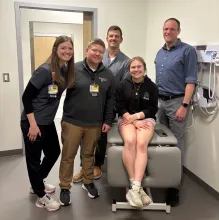
Specialized cartilage repair helps a young athlete get back on the court
For years, knee pain affected Mackenzie Sagers’ ability to play the sports she loved. After getting answers and expert care at UI Health Care, she’s pain-free and competing at a high level.
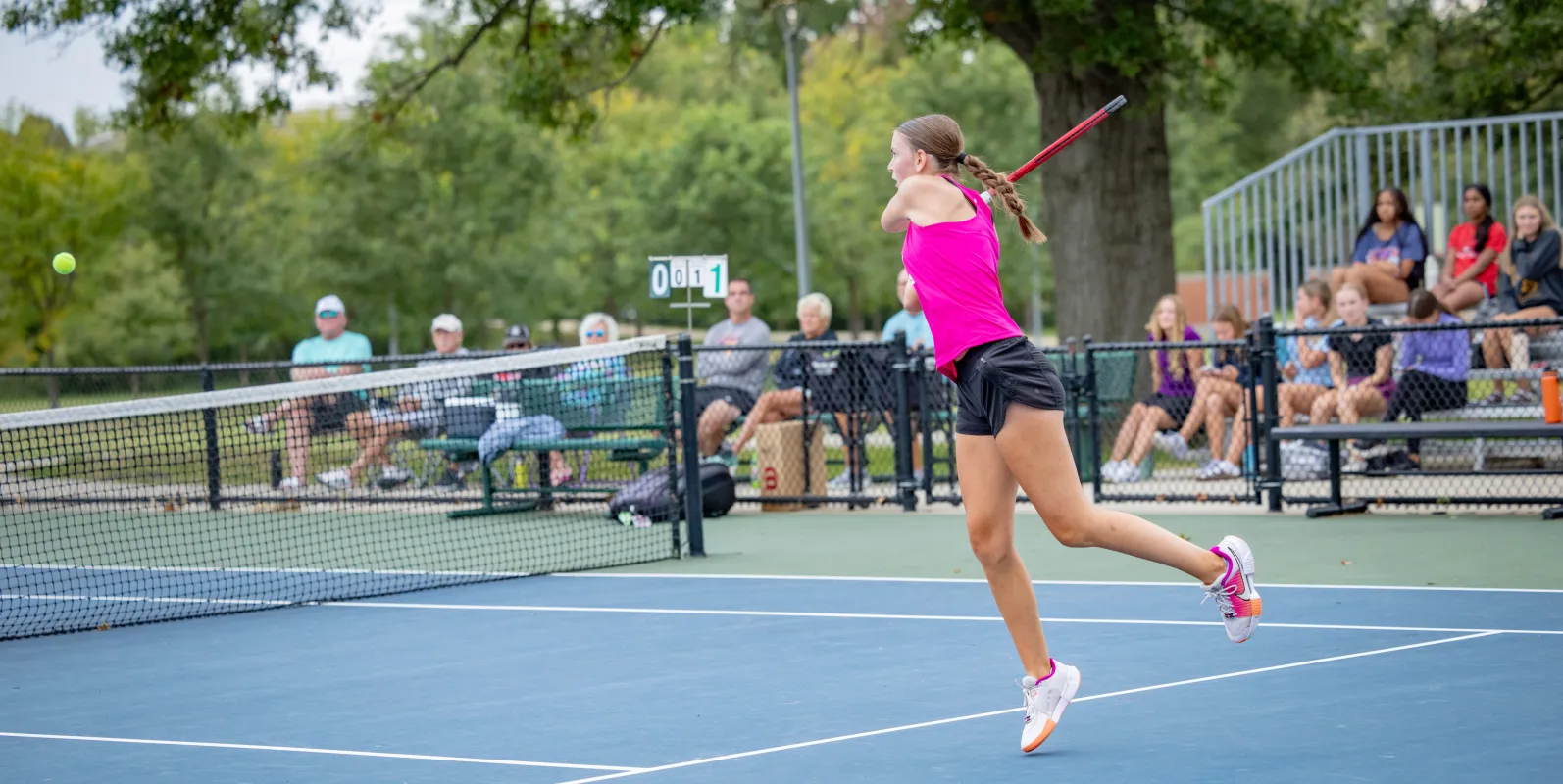
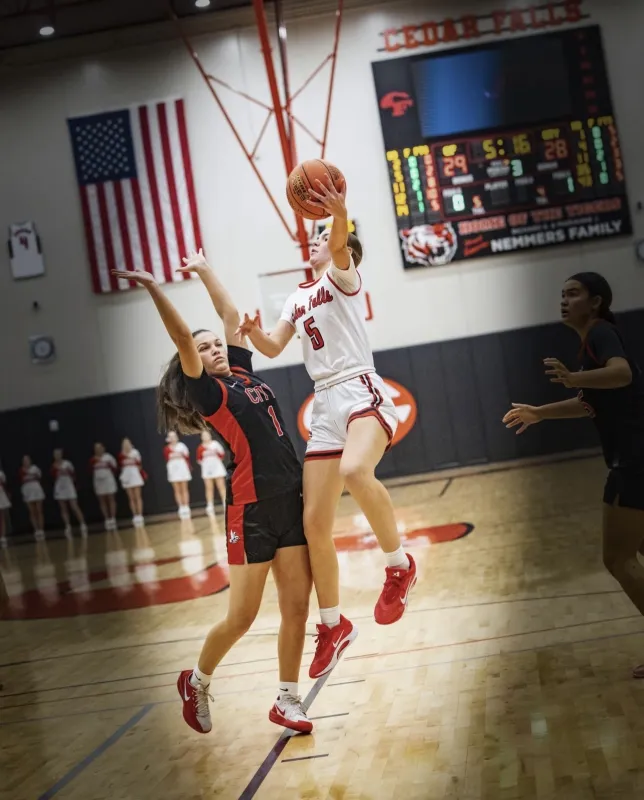
Mackenzie Sagers, a 17-year-old from Cedar Falls, Iowa, first noticed that something was wrong in middle school while playing basketball.
“It was a pain in my knee,” she says. “I knew that something just was off.”
There was no single fall or one moment that explained it.
“It just started hurting,” she says.
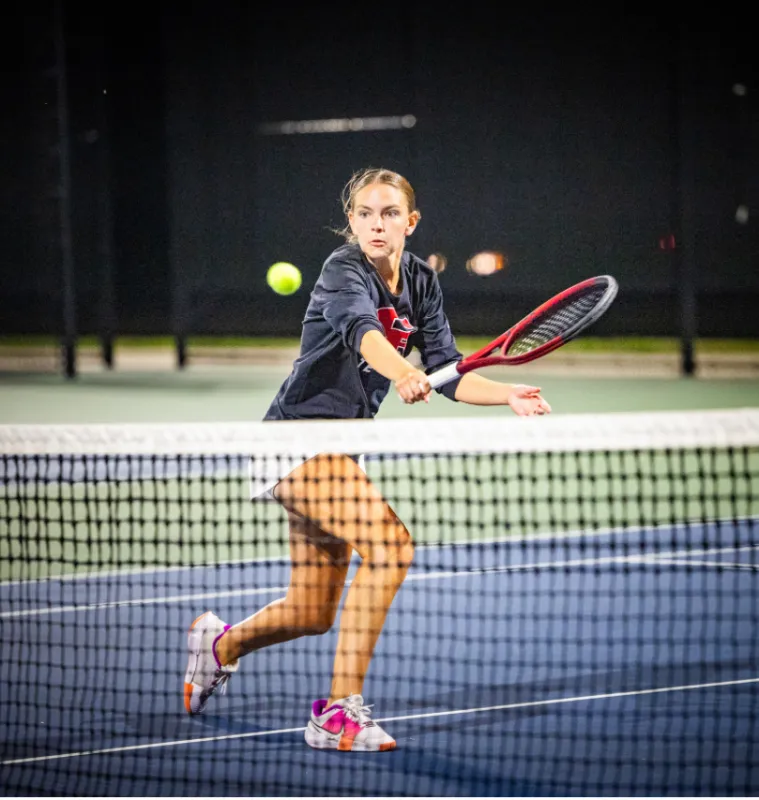
The knee pain started as an odd sensation. Over time, it began to affect her everyday movement and her ability to play sports. Every time she landed on her left leg while playing tennis, it hurt. Even walking began to feel uncomfortable, and she eventually developed a bit of a limp.
For her mother, Tara Sagers, the hardest part was watching the pain continue without clear answers.
“She actually went through the knee pain for about three years,” Tara Sagers says. “The doctors kept saying that it was growing pains. So, we did physical therapy, but it wasn't really working.”
Getting answers and choosing specialized expertise
The turning point came during a physical exam, when Mackenzie Sagers spoke up again about her knee. The doctor did an X-ray and saw something was wrong.
“We went to get an MRI, and that's when we found out I had to get surgery,” she says.
The diagnosis was osteochondritis dissecans, a cartilage condition in the knee that most often affects children and teens, especially those who play sports. Instead of a single injury, the cartilage that normally cushions and protects the joint had started to break down.
Some of that cartilage was chipping and breaking away from the end of Mackenzie Sagers’ femur (thigh bone), which made movement painful and affected how her knee functioned.
For Tara Sagers, that moment was overwhelming not only because of the diagnosis, but because of what it meant for her daughter’s sports seasons.
“The hardest part was knowing that the surgery would cause her to miss her sophomore year of basketball and tennis,” Tara Sagers says. “That was probably the hardest thing to watch her process.”
The family decided to seek care from a team with experience treating unique cases like hers.
“We decided we were going to go where they see more of these cases because it's such a rare thing,” Tara Sagers says.
That’s when they sought care from University of Iowa Health Care.
A major surgery and a long recovery
Brian Wolf, MD, MS, an orthopedic surgeon and medical director of sports medicine services at UI Health Care, suggested a specialized procedure.
“Given the size of the cartilage problem, we recommended that she have what we call a fresh osteochondral allograft,” he says. “We removed the chipping, damaged area of cartilage within her knee and transplanted a new piece of bone and cartilage into her knee to fill that defect.”
Recovery from the cartilage surgery would take time. That is one of the biggest challenges for a young athlete who is used to being active.
“In Mackenzie's case, she had to be on crutches for six weeks and not put any weight on her leg,” Dr. Wolf says. “We had to explain that she really couldn't run or jump for four to six months and that it typically takes six months to a year to get back to their sport.”
Mackenzie Sagers remembers how uncertain that felt and wondered if she’d ever play again.
The early part of her recovery was especially hard, and crutches were a challenge.
“It was also hard learning how to walk again,” Mackenzie Sagers says.
She started physical therapy soon after surgery and worked through each step of the process.
“I got a machine to bend my knee for me to make sure I'm still moving it,” she says. “After I started walking, we just progressed. I slowly started jogging, did pool and treadmill work, and started strengthening the knee with physical therapy.”
Wolf says Mackenzie Sagers’ commitment stood out.
“She was very, very eager to attack her recovery,” he says. “She was an excellent patient in terms of her physical therapy and following all the protocols.

Find a sports medicine specialist
When knee pain keeps a young athlete from the sports they love, expert care can make all the difference.
The support that helped her keep going
Mackenzie Sagers’ family, friends, and teammates helped her through the long recovery.
“My family and friends have always been there for me, whether it's my friends in the hallway carrying my backpack to my next classes or my parents always being there for me and making sure I'm okay,” she says.
She also stayed connected to her teams, even when she could not compete.
“She did not miss a single basketball practice or a single basketball game,” Tara Sagers says. “She sat on the bench, she did stats, she listened to coaches and what they were saying.”
Because her mother also coaches tennis, Mackenzie Sagers stayed close to that sport, too.
“I'm her tennis coach, so she was at all the tennis practices, at the tennis meets, and she was helping me coach on the sideline,” Tara Sagers says.
Mackenzie Sagers believes that time on the sideline shaped her as an athlete.
“I feel like helping coach my teammates during tennis made me a better player,” she says. “It really motivated me.”
Wolf says that kind of mindset matters during recovery.
“The biggest challenge is getting patients to understand that that process takes time,” he says. “Progress can be slow, and they need to look at it month by month and not day by day.”
Back to the sports she loves
When Mackenzie Sagers returned to tennis, the difference was immediate.
“It was very different because I never played without pain before,” she says. “I didn't even know how to play without having knee pain. I was just so relieved and glad I can finally play the sport I love without any pain.”
She says the recovery process has changed her.
“I came back stronger,” she says. “Mentally, definitely, I feel better. Physically, obviously, I'm better, because I can run and do all the things without pain.
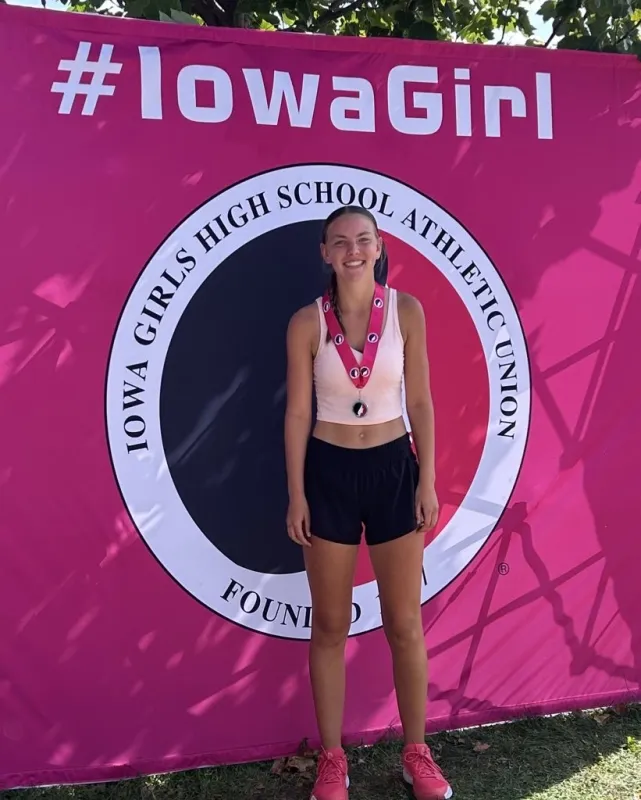
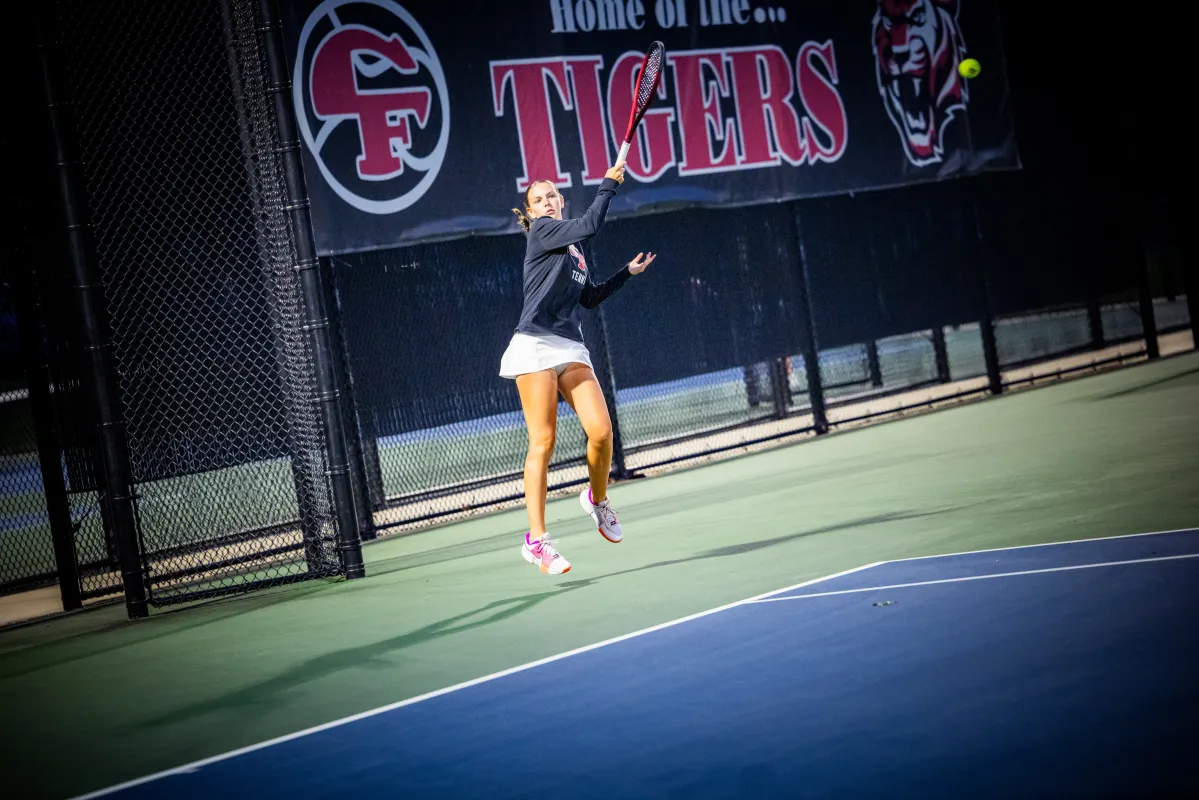
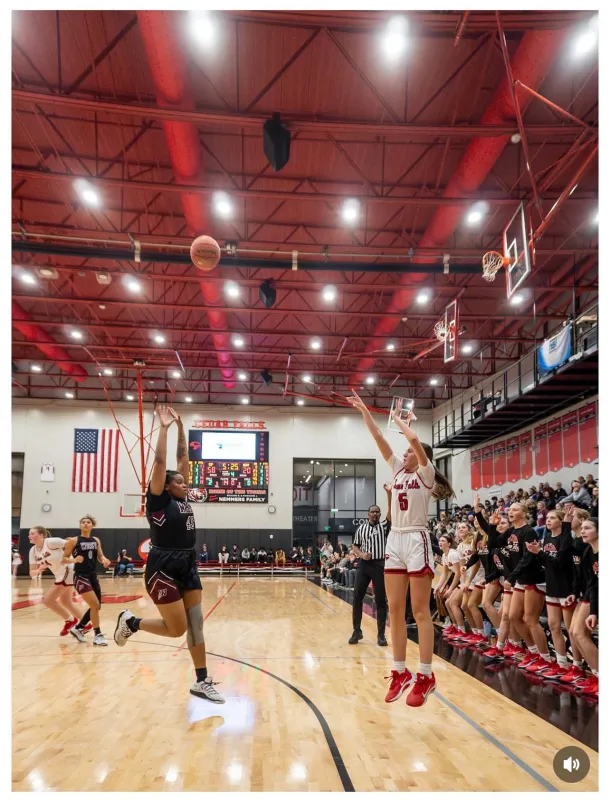
Her comeback included a standout tennis season. In fall 2025, she finished second in the state for singles, and her team finished third in the state. She has been accepted to play Division I tennis at the University of Northern Iowa, and she recently wrapped up her basketball season. She continues to stay active across both sports.
Wolf sees Mackenzie Sagers’ story as a powerful example of what specialized sports medicine care can make possible.
“She had a great success story,” he says. “She went through a very significant surgery that, historically, probably three decades ago, would have been kind of a career-ending type of thing, and she really did a fantastic job with her recovery. It’s impressive what she's been able to get back and do.”
How specialized sports medicine care helps young athletes recover
For young athletes facing a complex knee condition, sports medicine care goes beyond surgery alone.
“The ideal situation for sports medicine is providing not only the surgical care, but the guidance in their postoperative recovery to optimize their outcome,” Wolf says.
That guidance was important for the Sagers family, especially because recovery was long and detailed.
“The biggest support that we provide is educating them on the process,” Wolf says. “We try to make sure that they have a very defined and particular rehabilitation protocol.”
Tara Sagers says the experience with UI Health Care stood out from the beginning.
“I honestly can't say enough good things about them,” she says. “From the diagnosis to the day of surgery, the explanation of care, billing, follow-up appointments — everything ran smoothly. Dr. Wolf was one of the very best surgeons, and he had an amazing team.”
For Mackenzie Sagers and her family, the experience was more than surgery or recovery timelines. It was about getting back to the sports she loves and living without pain.
Today, she’s back on the court, competing at a high level, and looking ahead to the next chapter of her athletic career.
Patient Stories