How a referral to UI Health Care helped solve a complex heart condition
After years of defibrillator shocks and failed ablations, a referral to UI Health Care helped Heath Cooper of Clinton, Iowa, find relief for ventricular tachycardia — a potentially life-threatening condition.

For years, Clinton, Iowa, resident Heath Cooper managed heart issues that felt disruptive but controllable.
“I started getting light-headed at times,” he says. “I had some chest pains here and there.”
But in 2025, his condition became far more serious with several escalating episodes of ventricular tachycardia.
One morning, after getting out of the shower and walking into his living room, his implanted cardioverter defibrillator (ICD) began delivering shocks — internal electrical jolts that can be very painful but designed to stop life-threatening heart rhythms.
During Cooper’s ambulance ride to his local hospital that day, the defibrillator shocks kept coming.
“From the time I got into the ambulance to the time I got to the hospital, I was shocked 30 times,” he says.
It was one of multiple emergency episodes for Cooper. He had already undergone three cardiac ablations in the Quad Cities in an effort to stop the dangerous rhythm. But the relief never lasted.
Then he was referred to University of Iowa Health Care in September 2025.
Understanding why VT can be so difficult to treat
Ventricular tachycardia (VT) refers to a faster-than-normal heart rate that begins in the lower chambers of the heart, known as the ventricles. VT is not a single, uniform condition. According to Paari Dominic, MBBS, MPH, a cardiac electrophysiologist at UI Health Care, its complexity often explains why treatment doesn’t always work the first time.
“It’s a very complex cardiac arrhythmia, because ventricular tachycardia can have different types of mechanisms by which it can arise,” Dominic says.
Some forms of VT originate from relatively healthy tissue. Others arise from scarred areas of the heart muscle.
“They are different,” he explains. “The medications and strategy that we use for one form of VT may not be good for another.”
Location where the abnormal rhythm originates adds another layer of difficulty.
“They can come from inside the ventricular wall or outside the ventricular wall,” Dominic says. “If it’s coming from outside the ventricle, it’s so much more difficult to ablate.”
In Cooper’s case, this detail proved critical.
“Kudos to the physician who referred the patient to us,” Dominic says. “He knew that the tachycardia was coming from the outside of the heart.”
The referring physician also shared previous mapping data.
“He already gave us a clue where it’s coming from,” Dominic explains. “He did a previous map, and he shared that with us, so we were able to look at the map and say this is the place that he ablated and this is where we need to look.”
That careful reassessment helped the UI Health Care team identify a treatment approach that is uncommonly performed. Using specialized techniques to safely access that space, they performed an epicardial ventricular tachycardia ablation with a coordinated, high-volume team approach. The procedure successfully eliminated the arrhythmia focus that was causing the irregular rhythm.
Looking beyond the rhythm
For many patients with VT, heart failure is part of the clinical picture. Treating the rhythm alone may not be enough.
“The most important management strategy in those kinds of cases would be to treat the heart failure and not just the ventricular tachycardia,” Dominic says.
That balance is delicate.
“Patients who get ventricular tachycardia ablations are mostly patients who have heart failure,” he explains. “So, treating one can cause worsening of the other.”
Before proceeding with another ablation, Dominic’s team carefully evaluated Cooper’s stability and overall health.
“We have to determine if patients are good candidates for an ablation therapy,” he says. “We need to make sure that their comorbidities [other existing conditions or diseases], their heart failure status, and their age are a fit for ventricular tachycardia ablation.”
In Cooper’s situation, timing mattered.
“This patient was stable enough for us to map the tachycardia,” Dominic says. “We were able to find the focus of where the tachycardia was coming from.”

Recurrent VT after ablation?
If you’ve experienced repeated shocks, failed ablations, or ongoing ventricular tachycardia, a high-volume electrophysiology center can reassess your case and explore advanced treatment options.
A team built for complex VT care
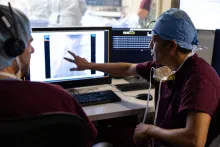
Ventricular tachycardia ablation requires more than technical skill. It requires coordination among electrophysiologists, heart failure and critical care doctors, anesthesiologists, support staff and even cardiothoracic surgeons.
“Two sets of eyes and two experts looking at it is better than one,” Dominic says, describing how he and a colleague approached Cooper’s case together.
He refers to the cardiac electrophysiology team at UI Health Care as “a well-oiled machine.” This team-based approach matters because, as Dominic notes, “ventricular tachycardia ablations can be very challenging and can carry a higher risk of complications compared to other ablations that we do.”
A different experience
For Cooper, one of the biggest differences at UI Health Care was how thoroughly the team communicated.
“I got all kinds of doctors that came to see me. They explained everything to me,” he says. “They went through everything — told me what was wrong, what was not wrong. What they can do, what they can’t do.”
After months of uncertainty and repeated shocks, that clarity eased some of Cooper’s fear.
“I didn’t worry as much because I knew that if something was going to happen, they were going to explain it to me,” he reflects. “They were going to take care of me.”
He appreciates how the team translated complex medical decisions into understandable terms.
“They broke it down to me,” he says.
Looking back, Cooper reflects on the importance of timing.
“I think that if I were with UI Health Care sooner, I would have been in a better shape than I am now.”
Today, though, he’s focused less on what might have been and more on living in the moment. Much of his time is spent at home in Clinton, taking care of his dogs, cooking, running errands, and managing his care one appointment at a time.
When referral makes sense
For providers managing recurrent or refractory VT, Dominic offers direct guidance.
“There are lots of studies now that show that if patients have failed one anti-arrhythmic drug, it might be better to ablate that patient rather than to add a second anti-arrhythmic drug,” he says.
If there are repeated unsuccessful procedures, Dominic says physicians should refer the patient to a center that performs a high volume of ventricular tachycardia ablation procedures.
UI Health Care receives patients from across Iowa and beyond.
“We get patients from all over the state and neighboring states for ventricular tachycardia ablations,” Dominic says.
For Cooper his referral marked a turning point not only in his treatment plan but also in his confidence in his team.
Patient Stories