If you develop pain and swelling in your knee within hours of injuring it, you should see an orthopedic specialist promptly. These symptoms may be a sign that you’ve torn your anterior cruciate ligament (ACL).
Without prompt, proper treatment, even minor ACL tears can cause complications. For example:
Your partially torn ACL could eventually rupture, requiring surgery (and a longer recovery).
You risk damaging other knee tissue located near your ACL, causing more pain and instability.
You have a higher risk of developing early osteoarthritis.
Fortunately, there are several nonsurgical and surgical treatments for a torn ACL—and University of Iowa Health Care offers them all. No matter your age or activity level, you’ll find the care and support you need to make a full recovery.
ACL tear symptoms and diagnosis
Your ACL is one of the strong bands of tissue that connects your thigh bone and shin bone. It also helps stabilize your knee joint.
It’s possible to stretch or tear your ACL during sudden or forceful movements. These include pivoting while running, landing awkwardly after a jump, or performing quick stop-and-start movements.
Although ACL tears can happen to anyone, they usually affect athletes and people with physically demanding jobs.
Symptoms of an ACL tear
You may realize the exact moment you tear your ACL. Many people hear or feel a “pop” or ripping sensation, followed by symptoms that may include:
Knee pain and swelling that occurs immediately after the injury or several hours later
Knee instability
Stiffness that causes reduced range of motion
Difficulty walking
Diagnosing an ACL tear
If you’ve injured your knee, it’s important to see an experienced orthopedic specialist—like those from UI Health Care.
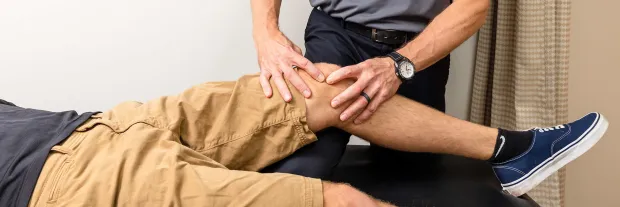
Our knee experts will confirm the type and severity of your injury. They’ll start with a physical examination and imaging tests, typically including an X-ray or MRI. .
In addition to helping us confirm your ACL injury, an MRI also reveals whether you’ve injured other knee tissue. Many people who tear their ACL also have a torn meniscus (a piece of cartilage that protects the knee joint).
Because our providers have treated so many people with ACL tears, they’re skilled at making treatment recommendations. They’ll then help coordinate and plan your treatments.
Treatments for a torn ACL
UI Health Care treats ACL injuries in people of all ages and abilities. This includes children and teens, moderately active adults, and high-level athletes.
Nonsurgical treatments for ACL tears
Not everyone with an ACL tear needs surgery. If you have minimal instability symptoms and you’re not very physically active, nonsurgical therapy may be all you need.
These treatments include:
Activity modification: Your provider may ask you to avoid any activities that increase your risk of re-injuring your ACL.
Orthopedic devices: You can keep your knee stable, and lower your risk of re-injury, by wearing a knee brace during certain activities. While you’re recovering, you may also need to use crutches to avoid putting weight on your knee.
Physical therapy: Our physical therapists can teach you exercises that improve your knee strength, flexibility, and range of motion. We can also help you strengthen the surrounding leg muscles that support your knee.
ACL surgery
For some people, surgery is the best (or only) treatment option for a torn ACL. This includes people who are young and/or highly active, and those with a completely torn ACL.
Surgery for a torn ACL is sometimes referred to as an ACL reconstruction.
During the procedure, your surgeon will replace your torn ligament with tissue from another part of your body (graft) or from a deceased donor (allograft). Specifically, we use part of a tendon (tissue that connects muscles and bones) taken from one of these areas:
The hamstring (tendons at the back of the thigh)
The patellar tendon (runs from the kneecap to the shinbone)
The quadriceps tendon (runs from the kneecap to the thigh)
Each type of graft or allograft has advantages and disadvantages. Our surgeons will draw on their extensive experience to determine which graft is best for you. They’ll assess factors such as your age, activity level, and (if applicable) what sport you play.
During most ACL surgeries, we use a minimally invasive technique called knee arthroscopy (or arthroscopic knee surgery).
With this approach, we only need to make a couple of small incisions around the joint. We use a tiny camera and miniature surgical tools to repair the knee through those incisions.
Recovering from ACL surgery
After surgery, we’ll help you get back on your feet with a customized rehabilitation and recovery plan.
You’ll work with physical therapists to improve your strength, balance, and range of motion. And if you need help getting back to the court, field, ice, or wrestling mat, you’ll have access to a rigorous return-to-sport program offered by our sports medicine specialists.
Our Care Team
Need treatment for a torn ACL?
When you contact UI Health Care, we’ll connect you with an orthopedic expert who specializes in treating ACL tears.