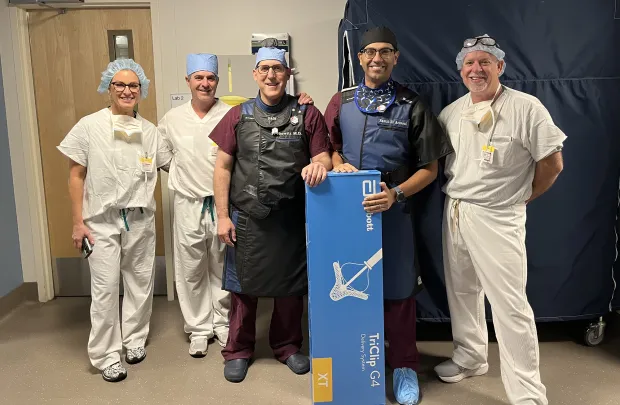
New aortic repair device improves patient survival and recovery
Patients who experience a specific type of aortic tear now have a new treatment option available at UI Health Care. The AMDS Hybrid Prosthesis, the…
For many patients with complex coronary artery disease (CAD), surgery is not an option because of their coexisting medical conditions or increased risk of complications.
That's why experts at UI Health Care Heart and Vascular Center are dedicated to providing the most advanced treatment options for high-risk patients with complex CAD.
Our interventional cardiologists specialize in complex and high-risk interventional procedures (CHIP) to treat the most difficult cases of CAD. This includes chronic total occlusion (CTO), which is a complete or nearly complete blockage of one or more coronary arteries.
CHIP procedures are performed in our state-of-the-art cardiac catheterization lab. Our lab uses the latest technologies to provide minimally invasive surgical interventions and improve outcomes to help you get back to your life faster.
UI Health Care Heart and Vascular Center experts are the most experienced in Iowa for treating patients with complex CAD.
Patients meet with our cardiologists, interventional cardiologists, and cardiac surgeons to determine the best treatment option for every individual. Together, our comprehensive heart team creates a personalized treatment and recovery plan that is designed to meet your individual needs.
This team includes:
Cardiac anesthesiologists
Cardiac catheterization lab nurses and staff
Intensive care unit (ICU) nurses
Mechanical circulatory device specialists
CHIP requires specialized skills, training, and equipment. There are a variety of techniques and approaches used during CHIP, including:
Diagnostic cardiac catheterization to help identify blockages
Angiograms and echocardiograms to see your blood vessels and heart
Intravascular ultrasound to produce images of the artery walls
Laser and rotational atherectomy to remove plaque from the blood vessels, especially calcified plaque
Specialized support devices to increase the safety and success rates of high-risk procedures
Special guide wires, balloons, and catheters that help reopen completely blocked arteries.
Because CHIP is most often used for patients who have already been diagnosed with high-risk CAD, heart failure, or severe heart valve disease, catheter-based devices such as ventricular assist devices (VAD) may be used during CHIP to help support the heart and blood flow.
Specialists at UI Health Care Heart and Vascular Center offer a highly advanced approach to treating patients with CTO, called chronic total occlusion percutaneous coronary intervention (CTO PCI). CTO PCI is a minimally invasive technique to treat patients with complete or nearly completely blocked coronary arteries. Historically, the only option to help these patients was coronary artery bypass grafting (CABG) or open-heart surgery. CTO PCI provides a new option for patients who do not qualify for surgery.
CHIP procedures are a great alternative for patients who have been turned down for traditional treatments for CAD due to the complexity or severity of their disease, anatomy, or comorbidities.
Factors that could make you a high-risk candidate for CHIP include:
Advanced age
A history of diseases such as diabetes, kidney disease, or stroke
Previous open-heart surgery
Complex heart artery anatomy
Previous unsuccessful coronary artery procedure
Chronic total occlusion (CTO)
UI Health Care CHIP specialists perform the largest volume of minimally invasive procedures in the state.