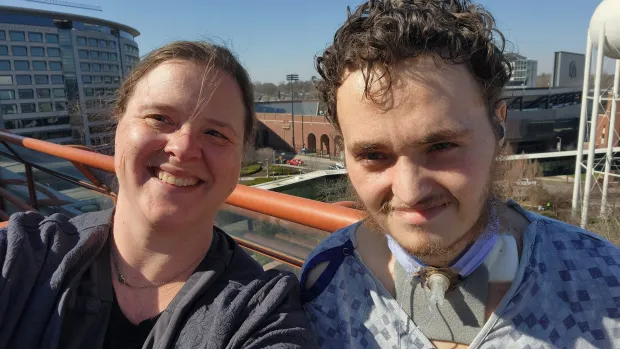
How critical care teams saved the life of a nurse’s stepson
Carol Haugen, BSN, RN, has spent her career supporting patients and families through some of their most difficult moments as an assistant nurse…
Extracorporeal membrane oxygenation (ECMO) is a life support therapy. It’s used if you’re critically ill with heart failure or lung failure and other treatments aren’t working.
The UI Health Care Heart and Vascular Center is internationally known for ECMO expertise. We’ve used ECMO to help patients from infants to adults for more than 20 years and have been named a Gold Level Center of Excellence. Our experts train medical professionals from all over the world in how to use ECMO.
While you’re on ECMO, we care for your family members, too. This family guide to ECMO provides in-depth information about how ECMO works, who’s on the care team, what to know about visiting, and much more.
If serious illness means that your lungs can’t get enough oxygen to your body, or if your heart isn’t able to pump enough blood, the ECMO machine takes over. It’s similar to the heart-lung machine that’s used during surgery.
ECMO isn’t a cure for any condition, but it takes the strain off your heart or lungs and gives them a chance to rest and heal.
When you’re on ECMO, your care team can lower the settings on your mechanical ventilator to give your lungs a break. They can also decrease the dosage of medications you’re on to help your heart and lung function.
Here’s what will happen if you need to be placed on ECMO:
The length of time people need to stay on ECMO varies. Your care team monitors you closely. When they start to see your bloodwork and vital signs improve, they can turn down the pump flow to see whether your heart and lungs can do more work on their own.
When you’re ready, your team will wean you off ECMO, although you might still need a breathing tube and ventilator.
After you come off ECMO, you’ll work with therapists who will help you get stronger and healthier. Your team will include specialists in cardiac rehabilitation, pulmonary rehabilitation, physical therapy, speech-language therapy, and occupational therapy.
Our teams provide ECMO for newborns, children, and adult patients who have life-threatening illnesses of the heart or lungs.
ECMO can help adults who have the following conditions:
ECMO can help children who have the following conditions:
ECMO can help newborns who have the following conditions: