Epilepsy: after two decades, musician is seizure-free
The operation called a temporal lobectomy changed Jeff Schulz’s life significantly. “I can make music! I can travel with singing groups! I can have a…
If you have epilepsy—or you’ve recently had seizures for the first time and don’t know why—it’s important to seek expert care. Without proper diagnosis and treatment, epilepsy and other seizure disorders can take a toll on your quality of life.
Neurologists from University of Iowa Health Care can pinpoint the cause of your seizures and help you control them.
We’re the first and only health system in Iowa accredited as a Level IV epilepsy center by the National Association of Epilepsy Centers (NAEC). This is the highest designation an epilepsy center can achieve.
Level IV NAEC accreditation confirms we have advanced testing that can distinguish epilepsy from nonepileptic seizures. It also verifies that we offer life-changing treatments for people whose epilepsy can’t be controlled with medication (intractable epilepsy).
The first step in preventing your seizures is to find out why you’re having them.
All seizures are associated with abnormal electrical activity in the brain, which can be measured on an electroencephalogram (EEG). Provoked seizures are caused by an acute head injury or infection, a systemic condition like low blood glucose, or a medication reaction. In other words, your normal brain is being provoked by some external factor.
Unprovoked seizures lack an immediate identifiable cause. Two or more unprovoked seizures fulfills the diagnosis of epilepsy—that is, an increased tendency of a brain to produce seizures.
Seizure mimics are episodes that might seem to be epilepsy but have no associated electrical activity on the EEG. Examples of this include:
UI Health Care offers more seizure testing options than anyone else in Iowa.
Depending on your medical history, including the frequency and severity of your seizures, you may have one or more of the following tests:
The treatments you’ll need depend on whether your seizures are caused by epilepsy or something else.
If we confirm that you do not have epilepsy, we’ll connect you with specialists who can treat the underlying cause of your episodes.
For example, if your episodes are caused by an arrhythmia, we can refer you to a UI Health Care cardiologist.
And if they are the result of PTSD (post-traumatic stress disorder), we’ll refer you to a psychiatrist or another provider who can help. With the right mental health care, it’s possible to overcome seizures caused by stress and trauma.
No matter the severity of your epilepsy, we offer treatments that can help. Our goal is to improve your safety and quality of life.
We also offer pediatric epilepsy care at UI Stead Family Children’s Hospital.
Roughly two-thirds of people with epilepsy can reduce or prevent their seizures with prescription medicine. These medicines go by several names, including antiepileptic drugs, antiseizure drugs, and anticonvulsants.
The type of medicine you’ll need depends on the type of epilepsy you have. Some drugs treat generalized epilepsy (your seizures occur in both halves of your brain). Others work better for focal epilepsy (your seizures start in a specific area on one side of your brain).
Our neurologists are skilled at choosing epilepsy medications that will offer you the most benefit with the fewest side effects.
And, if you’d like to try a promising new epilepsy drug before it’s widely available, we can help you enroll in a clinical trial.
If medication alone doesn’t control your seizures—or it causes serious side effects—you may need more advanced care.
A neuromodulation device may be an option if you aren’t ready (or eligible) for surgery. These small, implantable devices help prevent seizures by stopping the abnormal electrical activity that causes them.
UI Health Care offers:
For some people with intractable epilepsy, surgery is the best way to prevent seizures. We offer several procedures that remove or disconnect the part of the brain where seizures occur. These include:
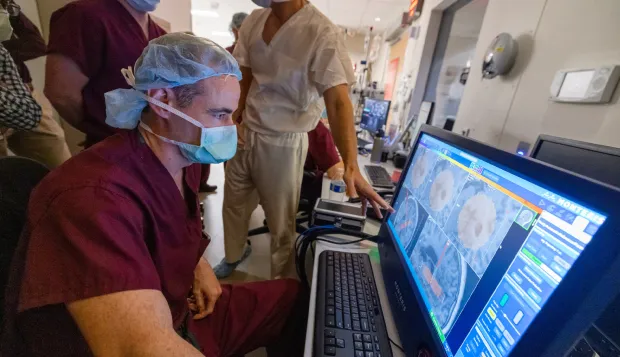
Today’s technology-driven surgical techniques make epilepsy surgery safer than ever. Using special planning procedures such as intracranial EEG, our neurosurgeons can map your brain ahead of time. This lets us see which sections of tissue to ablate or remove, and which sections to avoid.
We’re nationally recognized for our efforts to prevent sudden unexpected death in epilepsy (SUDEP).
Certain people with epilepsy—especially young adults who have a hard time controlling their seizures—have a higher risk of sudden death. When otherwise healthy people with epilepsy pass away without warning, it’s known as SUDEP.
Although you can lower your risk of SUDEP, there’s no clear way to prevent it—yet. UI Health Care researchers are working to change this.
We’re among a handful of medical centers in the U.S. and Europe taking part in an international research collaboration. This collaboration is called the Center for SUDEP Research (CSR), and it’s funded by the National Institutes of Health.
By bringing together top epilepsy experts from around the world, the CSR aims to pinpoint the causes of SUDEP—and then stop it from happening.
Our neurologists also conduct their own SUDEP research. We’ve discovered a link between serotonin levels in the brain and the development of epilepsy, depression, and SUDEP. We’re also investigating SUDEP risk factors and prevention techniques.
Join the Epilepsy Empowerment Group meetings to listen to speakers, share with others, hear the latest updates from the Epilepsy Foundation’s Iowa office, and discuss current issues related to epilepsy. Family, friends, and caregivers are welcome.
Register in advance on this link.
Join the Epilepsy Empowerment Group meetings to listen to speakers, share with others, hear the latest updates from the Epilepsy Foundation’s Iowa office, and discuss current issues related to epilepsy. Family, friends, and caregivers are welcome.
Register in advance on this link.